
New Jobs in 2027: 12 Roles AI Is Creating in India (From Real Job Postings)
By Skillancy Editorial Team · 26 November 2026 · 25 min read
Reviewed by Rishav Kumar, Principal Data Analyst, Walmart Global Tech
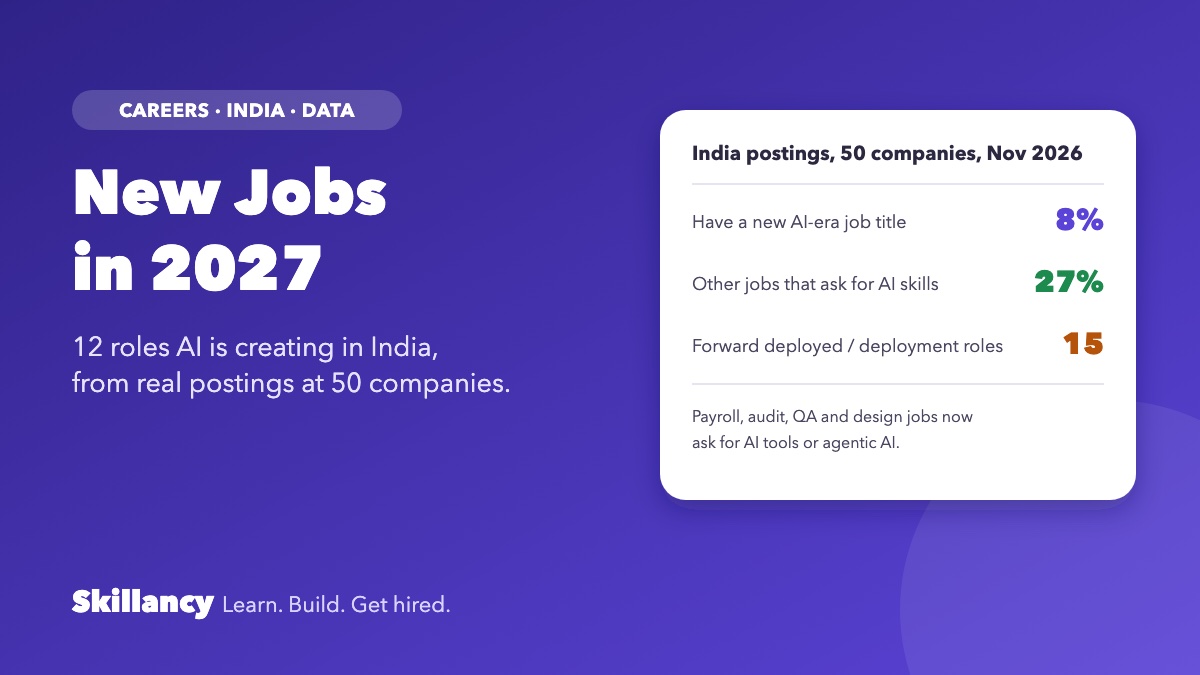
The new jobs of 2027 are mostly not science fiction. They are already being advertised, with titles that didn't exist in Indian job portals two or three years ago: forward deployed engineer, deployment strategist, AI success manager, AI data analyst, AI evaluation data scientist, even "Associate Manager, AEO" for getting a brand mentioned in ChatGPT's answers. To see which of these roles are actually hiring rather than just trending on LinkedIn, we read every India job posting on the public job boards of 50 companies on 26 November 2026, from OpenAI, Databricks, Razorpay, Meesho, Sarvam AI, Glean, Cursor and others. This guide covers the 12 new roles we found, what each one actually does, who is hiring, which skills the postings ask for and how to move into one from where you are now. It also covers the bigger change hiding in the data: more than one in four ordinary jobs now asks for AI skills, including payroll, internal audit, QA and design.
| Question | Short answer |
|---|---|
| What are the new jobs in 2027? | AI engineer, forward deployed engineer, deployment strategist, AI solutions architect, AI platform and inference engineer, AI product manager, AI evaluation specialist, AI success manager, AI business process analyst, AI data analyst, AI governance and tool admin, AEO manager |
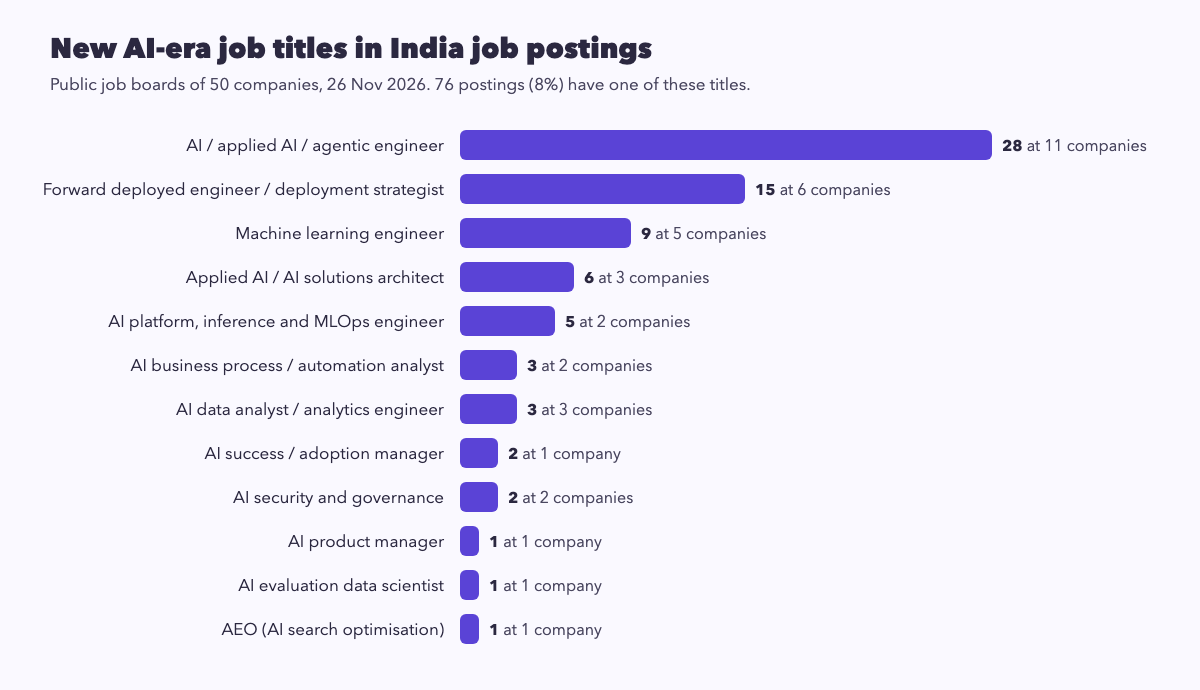
| Which new job has the most openings? | AI and applied AI engineer: 28 of 76 AI-era postings in our snapshot |
| Which is growing fastest? | Forward deployed engineer: Indeed counted about 19x more India postings in June 2026 than a year earlier |
| Do I need to code? | For the engineering roles, yes. AI success manager, AI business process analyst, AEO and AI tool admin need AI fluency and domain skills more than heavy coding |
| What if I don't want an "AI job"? | You still need AI skills: 27% of non-AI postings asked for them, from 16% in sales to 34% in product, marketing and design |
| What do these jobs pay? | We can't say from postings: barely 1% of them mentioned pay at all. Check salary data for the exact title and city |
| Where are they? | Mostly Bengaluru: more than two-thirds of postings (645), then Delhi NCR (100) and Mumbai (50) |
Learn it live: Want to move into one of these roles with a project that proves it? Explore our Generative AI program, or talk to a mentor for a plan that fits your background.
What the job market data says going into 2027
Before our own data, here's what the big public sources show. Our earlier post AI in 2027: careers, skills and what to learn covers the forecasts in depth, so this is just the short version:
- AI hiring is growing while IT services hiring shrinks. Naukri's JobSpeak index for September 2026 showed white-collar hiring up 2% year on year, AI/ML roles up 20%, and IT/software services hiring down 4%. Within IT, AI/ML hiring still grew 11%. Most of the AI/ML growth was for experienced people (13 to 16 years: up 54%), but fresher AI/ML hiring also grew 19%. Coverage of the October release reported AI/ML up 32%, but part of that jump is a festive-season base effect (Diwali fell in October 2025).
- AI engineer is the fastest-rising title in India's tech hubs. LinkedIn's Jobs on the Rise 2026 put AI engineer at number one in both Bengaluru and Hyderabad. A LinkedIn India executive said in August 2026 that AI engineering roles in India grew 51% in a year.
- Forward deployed engineering went from niche to mainstream. Indeed reported that FDE postings in India in June 2026 were nearly 19 times higher than a year earlier.
- Globally, AI and machine learning specialists are among the three fastest-growing jobs to 2030, behind big data specialists and fintech engineers, according to employers surveyed for the World Economic Forum's Future of Jobs Report 2025. The fastest-declining roles include data entry clerks and bank tellers.
These sources tell you that AI roles are growing. They don't tell you which titles companies actually advertise, or what those jobs involve day to day. That's what our snapshot is for.
How we found the new jobs: real postings from 50 companies
Many companies publish their open roles through job-board systems such as Greenhouse, Lever and Ashby, which offer free, public data feeds. Skillancy's careers portal already reads about 320 of these boards. On 26 November 2026 we pulled every open role from them and kept the ones located in India.
- 160 boards responded; the rest had moved or closed their public feed
- 50 companies had India openings: global software and AI companies (OpenAI, Databricks, Snowflake, MongoDB, Okta, Stripe, GitLab, Cursor, Glean) and Indian companies (Razorpay, Meesho, Sarvam AI, CRED, Groww, Zeta, InMobi, Pocket FM)
- Each India role counted once per company, title and city; 64% were posted since 1 September 2026
- Bengaluru dominates with 645 postings, then Delhi NCR (100), Mumbai (50), Pune (32), Chennai (31) and Hyderabad (17)
We then did two things in Python. First, we grouped job titles into new AI-era role families. Second, we searched each job description for AI skills, after removing the company's boilerplate. (Almost every company now opens with a line like "we are building the agentic enterprise", which says nothing about the job.) The method and its limits are explained at the end, and the code is in the folder for this article.
An important limit: these are mostly product and AI companies that use modern job boards. Large IT services firms, banks and government employers hire through their own portals and aren't included. Read the numbers as "what tech-forward employers are asking for now", not as a census of Indian jobs.
The 12 new jobs of 2027
For each role: what it is, real titles we saw, who was hiring, the skills the postings named, and who the role suits. Counts come from our snapshot, so small numbers mean "early", not "unimportant". Several of the most interesting roles appear only once or twice because they are brand new.
1. AI engineer (applied AI engineer, agentic systems engineer)
What it is: a software engineer who builds products and internal tools on top of large language models: agents, retrieval (RAG), tool integrations, evaluation and guardrails. It's not a researcher training models from scratch. It's the engineer who makes an LLM do useful, reliable work inside a real system.
- Real titles: AI Product Engineer · Applied AI Engineer, Enterprise AI · Senior AI Engineer, Enterprise Agentic Systems · Principal Software Development Engineer, Agentic Systems · SDE II, AI · Senior Software Engineer, AI Framework Integrations
- Hiring in our snapshot: 28 postings at 11 companies, including MongoDB, Databricks, Rubrik, Zscaler, GitLab and Toast
- Skills named in the role text: AI agents and agentic workflows (15 of 28 postings), LLMs (13), AI coding tools (6), evals (6), LangChain/LangGraph-style frameworks (4)
- What the work looks like: one enterprise agentic systems posting asks the engineer to build evaluation frameworks that measure agents' correctness, latency, cost, safety and task completion, with golden datasets and regression checks in CI/CD. An applied AI posting at GitLab asks for working prototypes "in days, not months" and a willingness to say when AI isn't the right answer.
- Suits: software engineers, and data scientists who code well
- Start with: Generative AI vs AI agents vs agentic AI, MCP vs A2A vs function calling and how to evaluate an LLM app
2. Forward deployed engineer and deployment strategist
What it is: an engineer who works inside a customer's business, finds where AI can help and ships a working system there, rather than building the core product back at headquarters. The deployment strategist is a newer, less technical variant: scoping problems, prototyping with LLM tools and driving adoption.
- Real titles: Forward Deployed Engineer, India · Forward Deployed Architect, Industry Solutions · Staff Forward Deployed Engineer · Deployment Strategist I and II · Strategic Deployment Engineer · AI Deployment Manager, India
- Hiring in our snapshot: 15 postings at 6 companies: Databricks, Cursor, Sarvam AI, MongoDB, Notion and Snowflake
- Skills named in the role text: LLMs (8 of 15), AI agents (6), RAG and vector search (3), MCP and tool calling (3)
- What the work looks like: Sarvam AI's deployment strategist works with enterprise and government clients, breaks business problems into requirements, builds prototypes with Python, APIs and LLM-based tools, then tracks adoption after launch. Cursor's FDE posting asks for people who have owned a customer outcome "not just a slide or a prototype".
- Suits: engineers who like talking to customers, solutions engineers, technical consultants, and analysts who code
- Go deeper: our full guide to the forward deployed engineer role
3. Machine learning engineer, now with LLM work
What it is: not a new title, but a changing one. Most of the 9 ML engineer postings in our snapshot are still classic machine learning: features, training, ranking, fraud and recommendation models, and serving them at scale. But 3 of the 9 asked for LLM experience in the role itself, and 2 named agent frameworks such as LangChain. Expect that share to grow: the companies' own descriptions of themselves already talk about LLMs and agents almost everywhere.
- Real titles: Machine Learning Engineer (L3) · Staff Machine Learning Engineer (L4) · Machine Learning Engineer II, Backend · Software Engineer, Machine Learning
- Hiring in our snapshot: 9 postings at 5 companies, including Twilio, Coinbase, InMobi, Zscaler and Glean
- Suits: data scientists and backend engineers with strong Python and statistics
4. Applied AI architect and AI solutions architect
What it is: the senior technical person who designs how a customer's systems will use AI: which models, which data, build versus buy, and how it reaches production. It sits between pre-sales engineering and architecture.
- Real titles: Applied AI Architect · Manager, Applied AI Architect (India) · Specialist Solutions Architect, AI/ML · Senior ML & AI Technical Solutions Engineer · AI System Architect, Agentic AI & Conversational AI
- Hiring in our snapshot: 6 postings at Databricks, OpenAI and Anaplan
- Skills named in the role text: AI agents (6 of 6), LLMs (4), RAG and vector search (3), evals (3), agent frameworks (3), MCP (2)
- Suits: experienced engineers, data architects and solutions engineers
5. AI platform, inference and MLOps engineer
What it is: the infrastructure behind AI products: serving models fast and cheaply, GPU clusters, deployment pipelines and monitoring. India's own model builders are hiring for this. Sarvam AI's inference performance engineer must be fluent in serving engines such as vLLM, SGLang or TensorRT-LLM.
- Real titles: Performance Engineer, Inference · Performance Engineer, Kernels · Platform Engineer, AI Infrastructure · ML Ops Engineer · Senior AI Platform Engineer
- Hiring in our snapshot: 5 postings at Sarvam AI and Zscaler
- Suits: backend, DevOps, SRE and systems engineers. Of the 12, this is the hardest to enter from a non-engineering background.
6. AI evaluation specialist (evals data scientist)
What it is: the person who decides whether an AI system is good enough, and proves it with numbers. They design test sets and quality metrics with domain experts, run evaluations before and after launch, and hunt for failure modes.
- Real title: Data Scientist, Evaluations (Sarvam AI). Evaluation work also shows up inside AI engineer and AI data analyst roles.
- What the work looks like: Sarvam AI's posting asks for someone "looking for what's wrong, not confirming what's right".
- Suits: data scientists and analysts who love statistics, experiment design and finding edge cases
- Start with: how to evaluate an LLM app with an eval harness in Python
7. AI data analyst
What it is: a new kind of analyst whose dataset is the AI's own behaviour. Glean's AI data analyst evaluates AI outputs, labels and categorises failure modes, maintains benchmark data and runs human labelling for workflows that include MCP and tool use. They turn messy quality complaints into structured signals the engineers can act on.
- Real titles: AI Data Analyst (Glean), plus analytics engineer roles at CRED and Juniper Square that now mention AI agents
- Suits: data analysts. This is one of the most natural next steps for analysts, because the core skills are the same: careful labelling, metrics and SQL, applied to AI quality.
- Start with: AI agents for analysts: 5 tasks to automate and data analytics with AI
8. AI product manager
What it is: a product manager who builds AI into the product, not one who just uses AI to write specs. Razorpay's Product Manager II, AI posting asks for someone who can prototype in hours, move across frontend, backend, data and LLM orchestration, and build in agents, evals, guardrails and feedback loops.
- Real title: Product Manager II, AI (Razorpay). Separately, 34% of ordinary product and program management postings asked for AI skills.
- Suits: product managers, and engineers or analysts moving into product
9. AI success manager and AI deployment manager
What it is: customer success for AI products. The job is to get a customer's people actually using the AI: finding use cases, designing workflows, running enablement and proving return on investment to executives. Glean's AI success managers shape "AI-powered ways of working" with enterprise customers. Cursor's AI deployment manager leads enterprise rollouts and turns high-impact use cases into repeatable workflows.
- Real titles: AI Success Manager (Glean) · AI Deployment Manager, India (Cursor)
- Suits: customer success managers, consultants, trainers and account managers who are fluent with AI tools. Heavy coding isn't required.
10. AI business process analyst (AI automation analyst)
What it is: a business analyst who redesigns a team's process around AI. Zscaler's AI business process analysts run discovery sessions with sales teams, map where sellers lack context, check data and feasibility with engineering, then write, test and refine prompts and output formats for AI-generated insights.
- Real titles: Staff AI Business Process Analyst, Go To Market · Senior AI Business Process Analyst (Partner/Channel Selling) · Inside Sales Lead, AI-Led Sales (InMobi)
- Suits: business analysts, sales operations, RevOps and process consultants. This is one of the most accessible new roles for non-engineers with domain knowledge.
11. AEO manager (answer engine optimisation)
What it is: SEO for AI answers. When people ask ChatGPT, Perplexity, Gemini or Google's AI Overviews "which payment gateway should I use?", which brands get mentioned and cited? Razorpay's AEO manager tracks the brand's visibility and citation share across these answer engines. They also define an "agentic readiness score" for how well the website and docs can be read by AI agents.
- Real title: Associate Manager, AEO (Razorpay)
- Suits: SEO specialists, content marketers and growth marketers. Combined with the 34% of marketing, design and content postings that now ask for AI skills, this is where marketing careers are heading.
12. AI governance, security and AI tool admin
What it is: making AI safe and controlled inside a company. Two very different shapes showed up. Meesho is hiring a security architect for AI-powered security engineering. Elastic's AI tool admin owns the configuration, system prompts and governance standards for the marketing team's approved AI tools, and is the final human review before agent-generated content goes live.
- Real titles: Security Architect, AI-Powered Security Engineering (Meesho) · AI Tool Admin (Elastic). Ordinary security postings also asked people to assess LLM applications, RAG pipelines and agentic workflows.
- Suits: security engineers, compliance and risk professionals, and marketing operations or IT admins. Industry reports describe AI governance as one of the largest skill gaps in India, so this group is likely to grow.
The bigger change: AI inside every job
New titles are only 8% of the market. The bigger story is what's happening to the other 92%.
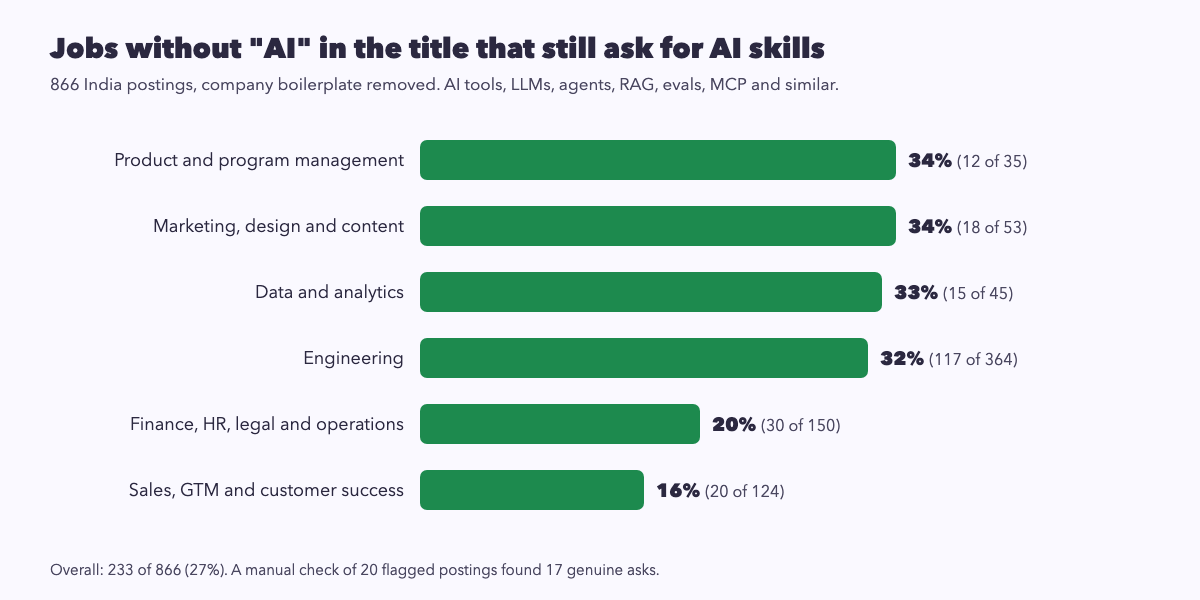
After removing company boilerplate, 233 of 866 postings without an AI-era title (27%) still asked for AI skills in the role itself. When we read 20 of these flagged postings by hand, 17 were genuine asks. The other 3 used "agent" in a non-AI sense or were describing the company's own product. So the true figure is likely between about 23% and 27%: roughly one in four ordinary jobs.
What that looks like in real postings (paraphrased):
- A people operations executive (Nivoda) is expected to use Claude, ChatGPT, Gemini and other AI tools, and the posting adds that they don't need to be a developer.
- An internal audit assistant manager (Groww) is asked to use generative AI, agentic AI and automation to change how audits are done.
- A QA automation engineer (NETGEAR) should keep up with AI-assisted test generation, maintenance and failure triage.
- A senior product designer (Zscaler) is expected to build live prototypes with AI tools such as Cursor, Devin and Claude.
- A finance technology product analyst (Okta) is asked to use GenAI or agentic AI to automate financial reconciliation.
- A systems engineer (Airbnb) configures AI agents and automation rules inside Jira.
Which AI skills are employers asking for?
Across the 866 postings without an AI-era title, counting the role text only:
| AI skill asked for | Postings |
|---|---|
| Using AI tools at work (ChatGPT, Claude, Gemini, Copilot, Cursor, AI-assisted workflows) | 133 |
| AI agents and agentic workflows | 94 |
| LLMs and generative AI | 92 |
| MCP and tool calling | 30 |
| RAG and vector search | 20 |
| Evals and AI quality | 14 |
| Prompting and context engineering | 11 |
| LangChain, LangGraph and other agent frameworks | 6 |
What this teaches. The most common ask is plain: use AI tools well in your daily work. "Prompt engineering" as a stand-alone skill barely appears (11 postings). Employers assume you can prompt and want to know what you have built or automated. Agent-related skills (agents, MCP, tool calling) are already more common than RAG.
Which jobs are shrinking?
Our snapshot shows what is being hired, not what is being cut, so we can't measure decline from it. The broader sources agree on the pattern. The WEF's employer survey lists data entry clerks, bank tellers and similar clerical roles among the fastest declining. Naukri shows IT/software services hiring falling even as AI/ML hiring grows. The roles most at risk are those made of repeatable steps with a clear right answer: data entry, first-level support scripts, basic reporting and routine testing. In our data, even those jobs are being redefined rather than simply removed: the QA, audit and support postings above all ask people to run and check AI, not to compete with it.
How to move into a 2027 job from where you are now
| If you are… | Natural 2027 roles | First project to build |
|---|---|---|
| A fresher (CS or IT) | AI engineer, ML engineer, deployment strategist | A small agent with 2–3 tools and an evaluation table, like our three-ways support bot |
| A data analyst | AI data analyst, AI evaluation specialist, analytics engineer, AI business process analyst | Label 50 real AI outputs, define failure categories and build a quality dashboard |
| A software engineer | AI engineer, forward deployed engineer, AI platform engineer | Add RAG, tool calling and evals to a product you know; measure cost and accuracy |
| In sales, pre-sales or customer success | AI success manager, AI deployment manager, solutions engineer for AI products | Run an AI rollout for your own team and measure adoption and time saved |
| In operations, finance or HR | AI business process analyst, AI tool admin, "AI-fluent" versions of your current role | Automate one painful monthly process with an AI tool and document before vs after |
| In marketing or content | AEO manager, AI-fluent content and growth roles | Track how ChatGPT, Gemini and Perplexity answer 20 questions about your category, and which sources they cite |
| In security or compliance | AI governance, AI security, AI tool admin | Write an AI usage policy and threat model for one real AI tool your company uses |
Two rules apply to every row. Proof beats certificates: the postings ask what you have shipped, measured or owned. And domain knowledge is an advantage, not baggage. The fastest-growing roles, forward deployed engineer, AI success manager and AI business process analyst, all reward people who understand a business problem deeply.
A 90-day plan to get ready for 2027
| Weeks | Focus | Output |
|---|---|---|
| 1–2 | Use AI tools daily in your current work. Keep a log of what saved time and what went wrong | Five before-and-after examples you can talk about in an interview |
| 3–4 | Learn the vocabulary properly: LLMs, agents, tool calling, RAG, evals. Read our GenAI vs agents vs agentic AI and embeddings guides | You can explain each term with an example |
| 5–8 | Build one project matched to your target role (see the table above) | A GitHub repo or write-up with real numbers |
| 9–10 | Add an evaluation: test cases, failure categories, cost and accuracy | The table that makes your project credible |
| 11–12 | Rewrite your resume around outcomes and AI. Target the real titles in this guide on LinkedIn, Naukri and company career pages | 20 targeted applications and two practice interviews |
Mistakes to avoid when planning for 2027
- Chasing a title instead of a skill. Titles are still unsettled: we saw "forward deployed engineer", "deployment strategist", "applied AI engineer" and "AI deployment manager" for overlapping work. Search for the skills, not just one title.
- Betting everything on "prompt engineer". Only 11 of 866 ordinary postings named prompting or context engineering as a skill. It's expected, not a job.
- Assuming AI jobs are only for engineers. AI success, AI business process, AEO and AI tool admin roles reward domain experts who are fluent with AI.
- Ignoring evaluation. Evals show up in AI engineer, AI data analyst, evaluation scientist and AI product manager postings. The ability to prove that an AI system works is one of the most transferable skills of 2027.
- Trusting trend lists without checking postings. Spend 30 minutes reading 10 real postings for your target role before planning months of study. That is exactly how this guide was built.
Key takeaways
- In India job postings from 50 companies (26 November 2026), 8% had a new AI-era title. The biggest groups were AI and applied AI engineers (28) and forward deployed engineers and deployment strategists (15).
- Twelve new roles showed up, from AI engineer and inference engineer to AI success manager, AI business process analyst, AI data analyst, AI evaluation scientist, AI tool admin and AEO manager.
- About one in four ordinary jobs now asks for AI skills: 27% of postings without "AI" in the title, highest in product, marketing, design, data and engineering (32–34%).
- The most requested AI skill is using AI tools well at work, followed by agents and LLMs. Stand-alone prompt engineering barely appears.
- Public data agrees: Naukri shows AI/ML hiring up 20% while IT services fell 4% (September 2026), and Indeed shows FDE postings up about 19 times in a year.
- The best preparation is one real project with an evaluation in the role you want, plus deep knowledge of a business domain.
Frequently asked questions
What are the new jobs in 2027?
The new jobs of 2027 are mostly roles that build, deploy and run AI inside companies: AI engineer, forward deployed engineer, deployment strategist, AI solutions architect, AI platform and inference engineer, AI product manager, AI evaluation specialist, AI data analyst, AI success manager, AI business process analyst, AI governance and tool admin, and AEO manager. All of them were already being advertised in India in November 2026.
Which new AI job has the most openings in India?
In our snapshot of India postings from 50 companies, AI and applied AI engineer roles had the most: 28 postings at 11 companies. Forward deployed engineer and deployment strategist roles came second with 15 postings at 6 companies. LinkedIn's Jobs on the Rise 2026 also ranked AI engineer as the fastest-growing role in Bengaluru and Hyderabad.
What is a forward deployed engineer?
A forward deployed engineer works directly with a customer's teams to find where AI or software can solve a real business problem, then builds and ships the solution in the customer's environment. Indeed reported that forward deployed engineer postings in India were nearly 19 times higher in June 2026 than a year earlier.
Which new AI jobs don't need coding?
AI success manager, AI deployment manager, AI business process analyst, AEO manager and AI tool admin focus on business processes, adoption, content or governance rather than heavy coding. They still need strong fluency with AI tools and the ability to judge AI output. Some AI product manager and deployment strategist roles want light prototyping in Python.
Will AI create more jobs than it destroys?
Globally, the World Economic Forum's Future of Jobs Report 2025 expects more jobs to be created than displaced by 2030, but in different roles from those that disappear. In India, Naukri data shows AI/ML hiring growing while IT services hiring declined in September 2026. The net effect depends heavily on the role. Repetitive clerical and support work is most exposed.
Do non-AI jobs now ask for AI skills?
Yes. In our snapshot, 27% of job postings without AI in the title asked for AI skills in the role itself, after removing company boilerplate. The share ranged from 16% in sales and customer success to 34% in product management and in marketing, design and content. Examples included payroll, internal audit, QA and product design roles.
What AI skills should I learn for 2027?
Start with using AI tools well in your daily work, which was the most requested AI skill in our data. Then learn how AI agents, tool calling and MCP work, how LLMs and RAG work, and how to evaluate AI output with test cases and metrics. Build one project in your target role and measure its results.
Is prompt engineering still a job in 2027?
Rarely as a job title. Only 11 of 866 ordinary job postings in our snapshot named prompting or context engineering as a skill. Employers assume basic prompting and care more about whether you can build, automate and evaluate AI-powered workflows.
What is an AEO manager?
AEO stands for answer engine optimisation. An AEO manager works to make a brand visible and correctly cited in AI-generated answers from tools like ChatGPT, Perplexity, Gemini and Google's AI Overviews, and makes websites and documentation easy for AI agents to read. Razorpay was hiring for this role in 2026.
What does an AI data analyst do?
An AI data analyst studies how an AI product behaves: they evaluate AI outputs, label failure modes, maintain benchmark datasets and turn quality complaints into structured metrics that engineers can act on. It is a natural next step for data analysts, because it uses the same skills of careful labelling, metrics and SQL.
Which city has the most new AI jobs in India?
Bengaluru, by a wide margin. In our snapshot, more than two-thirds of India postings (645) were in Bengaluru, followed by Delhi NCR with 100, Mumbai with 50, Pune with 32, Chennai with 31 and Hyderabad with 17.
How much do new AI jobs pay in India?
Salary varies widely by company, city and experience, and most postings don't say. Only about 1% of the India postings in our snapshot mentioned pay. For a realistic range, check salary data for the exact job title and city on salary-comparison sites, and ask recruiters directly.
Recommended reading and practice on Skillancy
- AI in 2027: What Changes for Data and AI Careers in India
- Forward Deployed Engineer: The Complete Guide
- Generative AI vs AI Agents vs Agentic AI
- How to Become an AI Engineer in India
- How to Evaluate an LLM App: Build an Eval Harness in Python
- Generative AI Career Roadmap for Non-Coders
- Data Analyst Interviews in the AI Era
- Generative AI Roadmap
Practice: Python interview questions · SQL interview questions · Free Python tutorial
Sources
- Skillancy analysis of India job postings from the public Greenhouse, Lever and Ashby job boards of 50 companies, collected 26 November 2026
- Naukri JobSpeak, September 2026 (Naukri blog): white-collar hiring +2%, AI/ML +20%, IT/software services −4%, AI/ML within IT +11%, fresher AI/ML +19%
- Careerindia on the October 2026 JobSpeak and Storyboard18 on the festive base effect
- Demand for forward deployed engineers jumps 19-fold in India (People Matters / PTI, 15 October 2026): Indeed data
- AI engineer is the fastest growing job role in Hyderabad: LinkedIn Jobs on the Rise 2026 (Deccan Chronicle) and Bengaluru coverage (Tripura Star News)
- AI jobs rise 51% in India: LinkedIn India head (Business Today, August 2026)
- Future of Jobs Report 2025: the fastest growing and declining jobs (World Economic Forum)
- India AI Workforce Analysis Report (Quess): AI governance skills gap
Methodology note
On 26 November 2026 we requested the public job-board feeds (Greenhouse, Lever, Ashby) of the roughly 320 companies tracked by Skillancy's careers portal. 160 responded. We kept postings whose location matched India or a major Indian city, and counted a role once per company, title and city, which left postings from 50 companies. Job titles were grouped into AI-era role families with keyword rules, checked by reading every matched title. To measure AI asks in ordinary jobs, we removed every sentence a company repeats across two or more of its different job titles (its boilerplate), then searched the rest for AI terms such as AI tools, ChatGPT, Claude, Copilot, LLM, generative AI, AI agents, agentic, RAG, MCP, evals and prompting. A hand check of 20 random flagged postings found 17 genuine asks. The sample over-represents product and AI companies and Bengaluru, and leaves out IT services firms, banks and government employers that don't use these job boards. It is a single snapshot, so it shows what is being hired now, not growth over time; growth figures come from the cited sources. Company names and job titles are as published in the postings, and descriptions are paraphrased. Salary figures are not given because only about 1% of postings mentioned pay.
Learn it live: Ready to build the skills these new roles ask for, with a project and a mentor? Explore the Generative AI program or Data Analytics with Agentic AI, or talk to a mentor. Learn. Build. Get hired.
Get the Skillancy field notes
One email a week: AI and analytics guides, cohort dates and hiring signals. No spam, unsubscribe anytime.