
How Data Analyst Interviews Have Changed with AI (2026): 7 Traps, 15 Examples and How to Prepare
By Skillancy Editorial Team · 23 October 2026 · 17 min read
Reviewed by Rishav Kumar, Principal Data Analyst, Walmart Global Tech
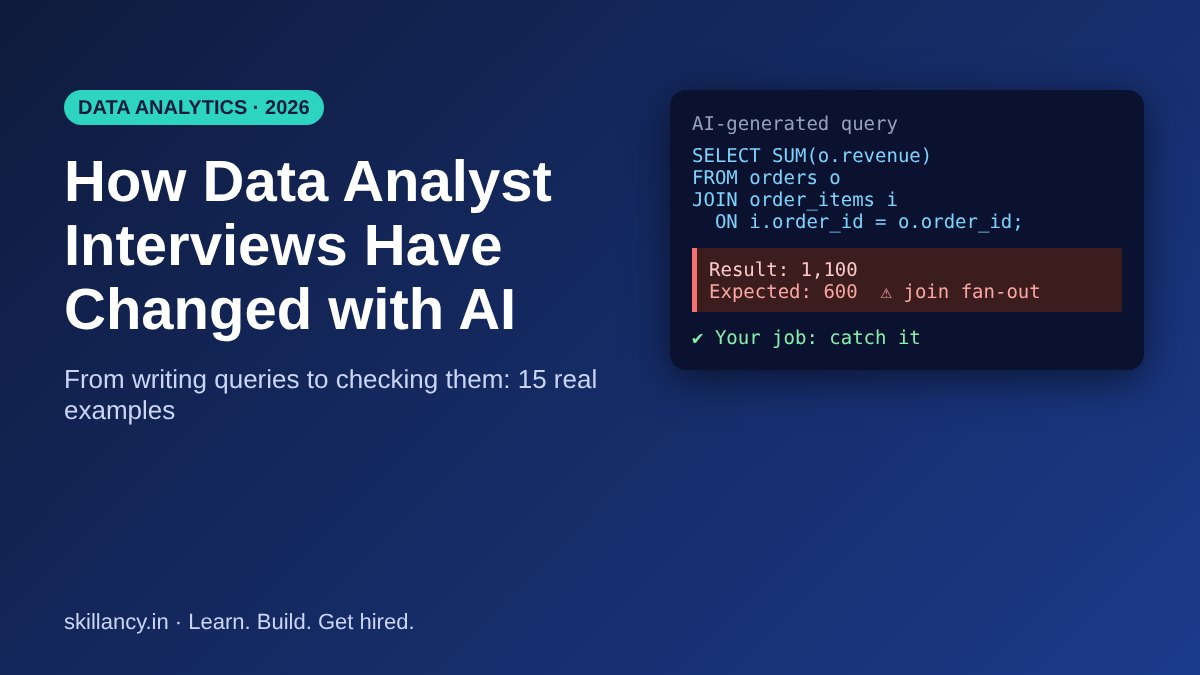
Every few weeks a candidate asks the same question on Reddit: what has actually changed in data analyst interviews now that everyone has AI? The honest answer is that the questions look similar, but the thing being tested has moved. Interviewers no longer need to find out whether you can write a query, because an AI assistant can draft one in seconds. They want to find out whether you can tell when that query is wrong, and whether you can explain the business decision it supports. This guide covers what changed, how companies treat AI in interviews, 15 realistic examples with the reasoning interviewers listen for, and three SQL traps run on real data so you can see the failure for yourself.
| Question | Short answer |
|---|---|
| Do interviews still test SQL and Python? | Yes, but as verification as much as writing |
| Is AI allowed? | Often, but policies vary by company and round, so ask |
| What fails candidates most? | Trusting AI output without checking it |
| What wins offers? | Clarifying the problem, validating results, explaining trade-offs |
| Biggest new round type? | Debugging AI output and defending a take-home live |
What actually changed in data analyst interviews
The topics are mostly the same: SQL, Python or Excel, statistics, metrics, and communication. What changed is the standard of evidence. Interviews moved from "can you produce an answer" to "can you prove this answer is right."
| Interview area | Before AI tools | In 2026 |
|---|---|---|
| SQL round | Write a query from scratch in a shared editor | Write or review a query, then explain how you checked it |
| Python round | Pandas syntax and data manipulation | Read AI-written code and spot silent errors such as dropped rows |
| Statistics | Define a p-value, name a test | Pick the right test for a messy scenario and defend the assumptions |
| Take-home | Submit a notebook | Submit, then defend every choice in a live walk-through |
| Case study | Size a metric drop | Same, plus "what would AI get wrong about this data?" |
| Communication | Present findings | Present findings and say what you verified yourself |
Do companies allow AI in data analyst interviews?
It depends on the company and the round. A 2026 CoderPad survey, summarised by Formation, reported that roughly 46% of companies now allow AI in technical interviews and another 20% decide case by case. Treat that as a snapshot of one survey, not a rule: a startup may encourage Copilot in a live exercise while a bank bans it in the same round.
What to do: ask the recruiter in writing before the interview. A message like "Is AI assistance permitted in the technical rounds, and if so, which tools?" is normal and shows professionalism. If AI is allowed, narrate how you use it. If it is not allowed, do not use it, even quietly.
Old interviews vs AI-era interviews: the key differences
| Dimension | Old-style interview | AI-era interview |
|---|---|---|
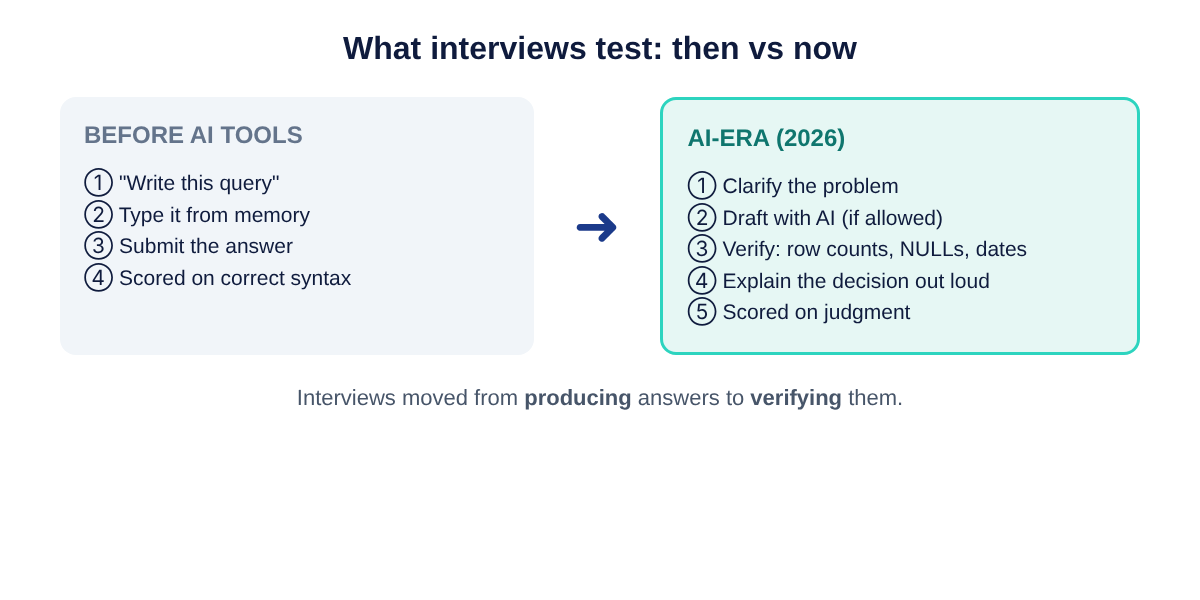
| What is scored | Correct final query | Reasoning, checks and communication |
| Typical prompt | "Write a query that returns..." | "This query returns 12% growth. Is that believable?" |
| Time pressure | Speed of typing | Speed of spotting what is off |
| Red flag | Syntax errors | Unquestioned output and no sanity checks |
| Green flag | Clean code | Clarifying questions and stated assumptions |
| Follow-up | "Can you optimise it?" | "How would you know if it were wrong?" |
Notice the pattern. Each row moves away from producing and toward verifying. That is the single idea to carry into your preparation.
Why AI-written answers fail: 7 traps interviewers set
AI models write fluent, confident SQL and Python. They fail in quiet ways that run without errors and produce believable wrong numbers. These are the seven traps that appear most often in AI-era rounds.
| Trap | What goes wrong | The check that catches it |
|---|---|---|
| Join fan-out | A one-to-many join duplicates rows, inflating sums | Compare row counts and totals before and after the join |
| Timestamp BETWEEN | The end date is treated as midnight, so the last day is cut off | Use a half-open range: >= start AND < next_day |
| NOT IN with NULL | One NULL in the subquery makes the whole filter return nothing | Use NOT EXISTS or filter NULLs explicitly |
| Average of averages | Averaging group averages ignores group size | Compute from totals: SUM(x) / SUM(n) |
| COUNT vs COUNT DISTINCT | Counting rows instead of unique users | Ask "what is one unit here?" before counting |
| Rank ties | ROW_NUMBER hides ties that DENSE_RANK keeps | Ask whether ties should share a rank |
| Silent dropna | Missing rows are dropped, shifting the result | Print the row count before and after cleaning |
Three of these are run on real data later in this post so you can see the numbers change.
15 real examples of AI-era interview questions
Each example uses the same three parts: the scenario you are given, what is really going on underneath, and how to handle it out loud.
| Area | Examples |
|---|---|
| SQL and data checks | 1 to 5 |
| Python and pandas | 6 to 7 |
| Statistics and experiments | 8 to 11 |
| Business and communication | 12 to 15 |
Example 1: The revenue number that is too good
The scenario: An AI-written query reports total revenue per customer segment. The total is 40% higher than the finance dashboard. The interviewer asks, "Ship it?"
What is really going on: A join to an order-items table turned one order row into several, so order-level revenue was summed once per item. This is join fan-out.
How to handle it: Say you would not ship it. Compare COUNT(*) and SUM(revenue) before and after the join, find the grain mismatch, and aggregate to the order level before joining.
Example 2: The missing last day
The scenario: A report for "1 to 31 January" uses BETWEEN '2026-01-01' AND '2026-01-31' on a timestamp column. Sales on the 31st look suspiciously low.
What is really going on: '2026-01-31' means midnight at the start of that day, so every order placed during the 31st is excluded.
How to handle it: Rewrite as >= '2026-01-01' AND < '2026-02-01' and say why half-open ranges are safer.
Example 3: The anti-join that returns nothing
The scenario: "Find customers who have never ordered." The AI used WHERE id NOT IN (SELECT customer_id FROM orders) and got zero rows, though you know such customers exist.
What is really going on: One order has a NULL customer_id. NOT IN against a list containing NULL evaluates to unknown, so every row is filtered out.
How to handle it: Switch to NOT EXISTS or add WHERE customer_id IS NOT NULL to the subquery, and mention you would also ask why an order has no customer.
Example 4: Average of averages
The scenario: The AI computes average order value per store, then averages those store figures to get a company-wide number.
What is really going on: A store with 10 orders counts as much as a store with 10,000. The result is not the true average.
How to handle it: Compute SUM(revenue) / COUNT(orders) across all rows, and explain the weighting difference in one sentence.
Example 5: Active users that are really events
The scenario: "Daily active users" is calculated as COUNT(user_id) on an events table.
What is really going on: That counts events, not people. A user who clicks 50 times is counted 50 times.
How to handle it: Use COUNT(DISTINCT user_id) per day, and confirm the product's definition of "active" before you start.
Example 6: The silent dropna
The scenario: An AI-generated pandas cleanup calls df.dropna() and the average order value rises.
What is really going on: Rows with missing discount values were dropped, and those rows happened to be the low-value orders. The data is now biased.
How to handle it: Print len(df) before and after, ask why values are missing, and choose between dropping, imputing or keeping the NaN deliberately.
Example 7: The merge that doubled the rows
The scenario: A pandas merge on customer_id returns more rows than the left table.
What is really going on: The right table has duplicate customer IDs, so each left row matched several rows.
How to handle it: Run right['customer_id'].is_unique first, or use validate='many_to_one' so pandas raises an error instead of silently multiplying rows.
Example 8: "The AI says the A/B test is significant"
The scenario: An AI summary says variant B won with p = 0.04. The interviewer asks if you agree.
What is really going on: You do not yet know whether the sample size was fixed in advance, whether the test was peeked at repeatedly, or how many metrics were checked. Any of these can make p = 0.04 misleading.
How to handle it: Ask about the design before the result, then check effect size and a confidence interval, not just the p-value.
Example 9: Mean or median for salaries?
The scenario: An AI report states "average salary is 18 LPA" for a team where two executives earn far more than everyone else.
What is really going on: A few extreme values pull the mean up. The typical employee earns less than the headline.
How to handle it: Show the median next to the mean, mention the skew, and say which one answers the stakeholder's real question.
Example 10: Correlation presented as cause
The scenario: The AI writes, "Customers who use the mobile app spend 30% more, so promoting the app will raise revenue."
What is really going on: Heavy spenders may simply be the people who install the app. The direction of cause is unproven.
How to handle it: Name the confounder, then propose an experiment or a matched comparison. Our guide on correlation vs causation walks through this in detail.
Example 11: Choosing the right test
The scenario: You are given conversion rates for two checkout pages and asked which test to run.
What is really going on: Conversion is a proportion, so a two-proportion z-test (or chi-square) fits. A t-test on 0/1 values is possible at scale but is the less direct choice. The interviewer wants to see you state assumptions: independent users, adequate sample size, a fixed stopping rule.
How to handle it: Name the test, state its assumptions, compute the result, and report the effect size with a confidence interval.
Example 12: The metric dropped 15%
The scenario: "Weekly orders fell 15%. An AI assistant says it is seasonal. What do you do?"
What is really going on: "Seasonal" may be right, but it is a hypothesis, not a finding. It could also be a tracking bug, a pricing change, or one region failing.
How to handle it: Segment by region, channel, device and product, check data pipelines first, and compare to the same week last year before accepting the AI's explanation.
Example 13: Explain it to a non-technical stakeholder
The scenario: You must explain why two reports disagree to a marketing head who does not know SQL.
What is really going on: This tests whether you understand the numbers well enough to simplify them. An AI can produce a paragraph, but only you know which part of it is true.
How to handle it: Lead with the answer in one sentence, give the cause in plain words ("one report counts orders, the other counts items"), and state what you recommend.
Example 14: Defending your take-home live
The scenario: You submitted a take-home. The interviewer asks, "Why did you remove these outliers?"
What is really going on: They are checking that you understand your own work. If an AI wrote part of it, you must still be able to justify every decision.
How to handle it: Give the rule you used, the impact on the result with and without the outliers, and what you would do with more time.
Example 15: "How do you use AI in your work?"
The scenario: A behavioural question, asked in almost every loop now.
What is really going on: Interviewers are testing whether you use AI responsibly: as a fast first draft, not as an authority.
How to handle it: Give a concrete example. For instance: "I use it to draft SQL and explain unfamiliar code, then I check row counts, spot-check a few records by hand and compare totals to a trusted source before I share anything." Also mention what you never paste into a public tool, such as customer data.
Practising these checks on real datasets is what makes them automatic. The free SQL tutorial and the practice SQL questions let you run queries in your browser, and Skillancy's Data Analytics with Agentic AI program adds live classes with interview-style exercises and mentor feedback.
See it in SQL: three traps with real outputs
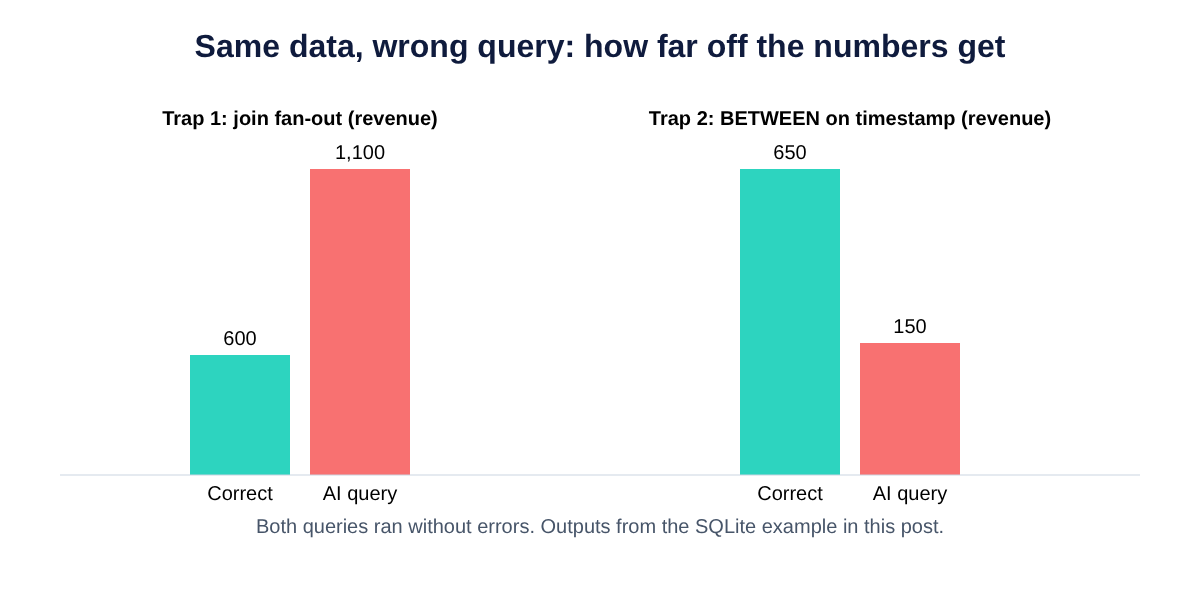
The three traps below were run on a tiny dataset in SQLite so you can see exactly how the numbers change. The data: 4 customers, 4 orders (revenue 100, 200, 300 and 50, total 650), and an order_items table with 6 rows. Order 104 has a NULL customer_id.
Trap 1: join fan-out
SELECT SUM(o.revenue)
FROM orders o
JOIN order_items i ON i.order_id = o.order_id;
Output: 1100
The orders that have items are worth 100 + 200 + 300 = 600. The query returns 1,100 because order 101 has 3 items and order 103 has 2, so their revenue is counted 3 and 2 times. A quick COUNT(*) after the join returns 6 rows from a 3-order set, which is the clue. The fix is to aggregate before joining or use EXISTS:
SELECT SUM(o.revenue)
FROM orders o
WHERE EXISTS (SELECT 1 FROM order_items i WHERE i.order_id = o.order_id);
Output: 600
Trap 2: BETWEEN on a timestamp
SELECT COUNT(*), SUM(revenue)
FROM orders
WHERE order_ts BETWEEN '2026-01-01' AND '2026-01-31';
Output: 2, 150
Two orders were placed on 31 January at 15:30 and 10:00, and both are missing. The half-open version returns all four orders:
SELECT COUNT(*), SUM(revenue)
FROM orders
WHERE order_ts >= '2026-01-01' AND order_ts < '2026-02-01';
Output: 4, 650
The wrong query lost 500 of 650 in revenue, 77%, without raising any error.
Trap 3: NOT IN with a NULL
SELECT customer_id FROM customers
WHERE customer_id NOT IN (SELECT customer_id FROM orders);
Output: (no rows)
Customer 4 has never ordered, but the query returns nothing because one order has a NULL customer_id. Rewrite with NOT EXISTS:
SELECT customer_id FROM customers c
WHERE NOT EXISTS (SELECT 1 FROM orders o WHERE o.customer_id = c.customer_id);
Output: 4
The lesson: all three wrong queries ran cleanly. Only a habit of checking row counts, date boundaries and NULLs catches them, and that habit is what AI-era interviewers are looking for. You can run these queries yourself in the free SQL compiler.
How to prepare for a data analyst interview in the AI era
| Skill | Old way to practise | AI-era way to practise |
|---|---|---|
| SQL | Solve 100 problems | Solve fewer, then break each solution: add NULLs, duplicates and ties |
| Python | Memorise pandas syntax | Review AI-written code and predict where it silently fails |
| Statistics | Learn definitions | Explain test choice and assumptions out loud |
| Business sense | Read case studies | Practise metric drops and "is this number believable?" |
| Communication | Rehearse a pitch | Record yourself explaining a result in 60 seconds |
| AI use | Avoid or hide it | Build a short, honest workflow you can describe |
A 4-week plan
| Week | Focus | Output |
|---|---|---|
| 1 | SQL checks: joins, NULLs, date ranges, ties | 10 queries, each with a written sanity check |
| 2 | Python and pandas: cleaning, merges, validation | 3 notebooks that print row counts at each step |
| 3 | Statistics and experiments: tests, intervals, power | 5 worked A/B test write-ups |
| 4 | Mock interviews and take-home defence | 2 recorded mock rounds, reviewed |
Practise with the SQL interview questions and Python interview questions already on Skillancy, and read our data analyst interview questions guide, then do each one again as the reviewer of an AI-written answer.
The five-question checklist
Before you trust any query or analysis, in an interview or at work, ask:
- What is one row? Is the grain what I think it is?
- Did the row count change? Compare before and after every join or filter.
- What about NULLs and ties? Where could they silently change the answer?
- Do the totals match a trusted source? A dashboard, a finance report, a hand count.
- Could I explain this to a non-technical person? If not, I do not understand it yet.
How to answer "How do you use AI in your work?"
This is the question most candidates fumble, either by pretending they never use AI or by sounding like they rely on it blindly. Here is an answer structure that works.
"I use AI as a fast first draft, never as the final word. For example, I'll ask it to draft a SQL query or explain an unfamiliar function. Then I verify: I check row counts before and after joins, spot-check a few records by hand, and compare totals against a trusted source such as the finance dashboard. I also don't paste confidential customer data into public tools. That way I get the speed without inheriting its mistakes."
Book a mock interview. Rehearsing this answer out loud, with a mentor who pushes back, is the fastest way to make it sound natural. Book a mock interview with Skillancy.
Common mistakes candidates make
- Trusting the first output. Running AI-written code and reporting the number without a single check.
- Hiding AI use. If AI is allowed, concealing it looks worse than explaining it. If it is not allowed, using it risks the offer.
- Skipping clarifying questions. Jumping to code before asking what "active user" or "revenue" means.
- Memorising answers. Interviewers now ask follow-ups specifically to catch memorised or AI-generated responses.
- Ignoring the business context. A correct query that answers the wrong question still fails.
- Not being able to defend the take-home. Submitting work you cannot explain line by line.
- Over-explaining syntax. Spending the round on how the code works instead of what the result means.
Frequently asked questions
How have data analyst interviews changed with AI?
The topics are the same, but the emphasis moved from writing code to verifying it. Expect questions where you review AI-generated output, find silent errors, and defend your reasoning out loud.
Can I use ChatGPT or Copilot in a data analyst interview?
Only if the company says so. Surveys suggest many employers now allow it in some rounds, but policies differ by company and round. Ask the recruiter in writing, and never use AI secretly.
Do I still need to learn SQL if AI can write it?
Yes. You cannot catch a join fan-out, a timestamp boundary error or a NULL trap in a query you could not have written yourself. SQL is now partly a reviewing skill.
What AI-related questions do interviewers ask?
Common ones: "How do you use AI in your work?", "Here is an AI-generated query, what is wrong with it?", "How would you validate this result?" and "What would you never paste into an AI tool?"
How do I answer a question when I use AI to help?
Name a task, say what you asked the AI to do, and describe how you verified the output. Concrete checks such as row counts and comparison to a trusted source make the answer credible.
What is a live defence of a take-home?
After you submit a take-home, the interviewer asks you to walk through it and justify choices such as outlier handling, metric definitions and chart selection. It checks that you understand the work you submitted.
Which statistics topics matter most now?
Hypothesis testing, confidence intervals, A/B test design (sample size, peeking, multiple comparisons), and telling correlation from causation. These are the areas where AI summaries are most often confidently wrong.
Will AI replace data analysts?
AI is automating routine query writing and chart drafting, which changes the job rather than removing it. Demand is shifting toward analysts who can check AI output, understand the business, and communicate decisions.
Recommended internal links
- Correlation vs causation, the statistics idea behind Examples 8 and 10: https://skillancy.in/blog/correlation-vs-causation
- Data analyst interview questions with model answers: https://skillancy.in/blog/data-analyst-interview-questions
- Python for data science, including an A/B test: https://skillancy.in/blog/python-for-data-science
- Free online SQL compiler: https://skillancy.in/tools/sql-compiler
- SQL interview questions with a live editor: https://skillancy.in/practice/sql-questions
- Data Analytics with Agentic AI program: https://skillancy.in/courses/data-analytics-with-agentic-ai
Sources and publishing references
Formation, summary of the 2026 CoderPad survey (46% of companies allow AI in technical interviews, 20% decide case by case): https://formation.dev/blog/ai-assisted-coding-interviews
Spider 2.0: Evaluating Language Models on Real-World Enterprise Text-to-SQL Workflows (best agent solved about 21% of tasks at launch, versus 91% on Spider 1.0 and 73% on BIRD): https://www.alphaxiv.org/abs/2411.07763v2
Data Driven, AI use on take-homes: https://datadriven.io/blog/80-of-des-use-ai-on-take-homes-now-what
Tech Interview Handbook, what changed in tech interviews in 2026: https://www.techinterview.org/post/3233475417/what-changed-tech-interviews-2026/
Tech Interview Handbook, using AI tools in tech interviews: https://www.techinterview.org/post/3233474910/using-ai-tools-tech-interviews-2026-canon/
DataCamp, how to prepare for a data analyst interview: https://www.datacamp.com/blog/how-to-prepare-for-a-data-analyst-interview
Kore1, data analyst interview questions 2026: https://www.kore1.com/data-analyst-interview-questions-2026/
Washington State University, data analyst interviews are changing with AI: https://ascc.wsu.edu/blog/2026/07/15/data-analyst-interviews-are-changing-with-ai/
All SQL outputs on this page were produced by running the queries on a small in-memory SQLite dataset (4 customers, 4 orders, 6 order items), so you will get the same numbers. Survey percentages are as reported by the cited sources and may change in later editions.
Get the Skillancy field notes
One email a week: AI and analytics guides, cohort dates and hiring signals. No spam, unsubscribe anytime.