
AI in 2027: What Changes for Data and AI Careers in India, and What to Learn Now
By Skillancy Editorial Team · 6 November 2026 · 13 min read
Reviewed by Rishav Kumar, Principal Data Analyst, Walmart Global Tech
Every January, someone publishes a list of "AI predictions for the year", and by March most of them are forgotten. 2027 is different for one practical reason: it is the year many of the forecasts made in 2023 to 2025 were pinned to. Analysts said that by 2027 agents would be common in enterprise software, that most new analytics content would involve generative AI, and that India would have far more AI roles than trained people to fill them. We are now close enough to that date to check which of those claims look believable, and what they mean if you are a student, an analyst or a working professional deciding what to learn next. This guide separates the forecasts you can plan around from the ones to treat with caution, explains the four shifts that matter, maps them to roles, and ends with a 60-day plan you can start this month.
| Question | Short answer |
|---|---|
| Will AI take analyst and data jobs in 2027? | Forecasts point to tasks changing faster than roles disappearing. Routine reporting shrinks; judgement, validation and design of AI workflows grow |
| Is there really an AI talent gap in India? | Bain & Company forecast about 2.3 million AI-related openings by 2027 against roughly 1.2 million available people |
| What will employers expect? | Working comfort with AI tools as a baseline, plus proof you can check AI output and connect it to a business decision |
| Which skills last? | SQL, statistics, Python, data modelling and clear communication, because AI systems are only as good as the data and questions they get |
| What new skill is worth adding? | Building and evaluating a small agent workflow with guardrails, logs and a human approval step |
| Where do I start? | Pick one repetitive task, automate part of it with AI, measure the time saved and write it up as a portfolio project |
What do the 2027 forecasts actually say?
Most "by 2027" numbers come from a handful of sources, and it helps to know which is which before you plan a career around them.
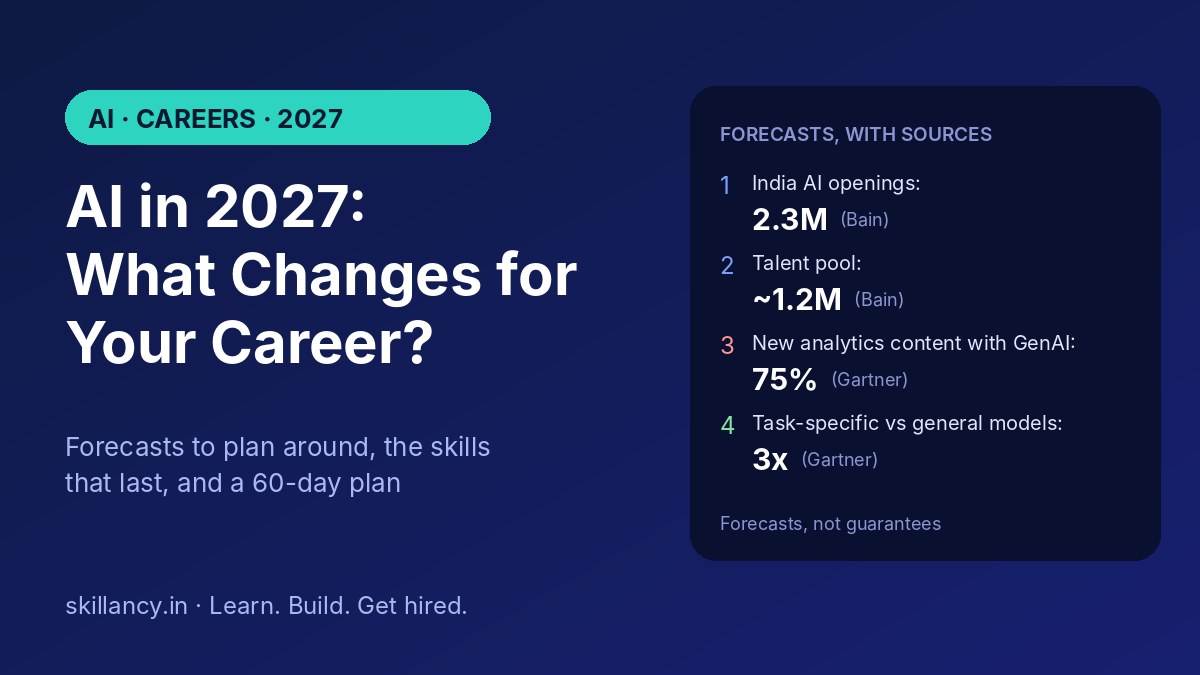
Gartner on analytics. Gartner has said that by 2027, 75% of new analytics content will be contextualised using generative AI, and that 20% of business processes will be executed autonomously by augmented analytics platforms. The analyst quoted in coverage framed it as a move from tools that support decisions to tools that make them.
Gartner on agents. Gartner expects that by 2027 about one-third of agentic AI implementations will combine agents with different skills to handle complex tasks inside application and data environments. In plain terms: not one clever chatbot, but several narrow agents that hand work to each other.
Bain & Company on talent. A March 2025 Bain report forecast that AI-related job openings in India would reach about 2.3 million by 2027, while the talent pool would grow to only about 1.2 million. It also estimated that India would need to upskill more than a million workers to close the gap.
TeamLease Digital on capability centres. Its report projects that India will host over 2,100 global capability centres (GCCs) employing around 3 million people by 2027, and that GCCs will generate over 1.2 million of the 4.7 million new tech jobs forecast for that year, particularly in GenAI and engineering R&D.
How to read these honestly:
1. They are forecasts, and most were written in 2025 or earlier. Treat them as direction, not destiny.
2. They measure openings, not outcomes. A forecast of 2.3 million openings does not mean every applicant will be hired. Employers are hiring for evidence of skill, not for the word "AI" on a certificate.
3. Vendors and consultancies have incentives. A firm selling AI services benefits when the market looks large. That does not make the numbers wrong, but it is why we cite several independent sources and name each one.
Shift 1: from chatbots to agents that do work
The first wave of generative AI answered questions. The second wave, which is what 2027 forecasts describe, takes actions. An agent observes a situation, decides on a next step, uses tools such as a database, a spreadsheet, an email system or a ticketing tool, checks its own result and escalates to a person when it is unsure.
For people who work with data this is already concrete. A text-to-SQL helper that drafts a query is a chatbot feature. A workflow that pulls last week's numbers, flags a 19% drop in one region, drafts the explanation and asks you to approve before it sends is an agent. We covered the difference, with working examples, in our guide to agentic AI in everyday analytics tasks, and showed how the same pattern applies to operations in AI agents in supply chain and logistics.
What this means in 2027: the valuable person is not the one who can prompt an agent. It is the one who can decide what an agent may do alone, verify what it did, and fix it when it is wrong. That is a data skill as much as an AI skill.
Shift 2: AI becomes a layer inside jobs, not a job title
A recurring theme in India's 2027 hiring commentary is that the best opportunities may not carry "AI" in the title. A software engineer who builds applications on top of language models, a data engineer who prepares governed data for retrieval, an analyst who runs agent-assisted reporting: each is doing an AI job under an ordinary name.
Gartner's hiring prediction, as summarised by training providers, points the same way: AI proficiency is expected to become a standard requirement in a large share of hiring processes by 2027. Treat that specific percentage with caution because it reaches us second-hand, but the direction matches what recruiters describe.
Two practical consequences:
- Search for the work, not the label. Read job descriptions for phrases like "LLM", "agent", "retrieval", "automation", "evaluation" and "stakeholder", not only for "AI engineer".
- Show AI inside a real workflow. A project where AI shortens a task you already understand is more convincing than a generic chatbot demo. The roles and skills behind this are laid out in our guides to becoming an AI engineer in India and the forward deployed engineer role.
Shift 3: smaller task-specific models, and governance as a differentiator
Gartner has predicted that by 2027 enterprises will use task-specific AI models about three times more often than general-purpose large language models when building AI tools. The reasoning is practical: a smaller model tuned for one job is cheaper, faster, easier to test and easier to keep inside a company's data boundary.
This changes what "knowing AI" means. Calling one big model through an API is the starting point. Employers increasingly need people who can:
- decide whether a task needs a large general model, a smaller specialised one, or no AI at all;
- build a check step so bad output is caught before it reaches a decision;
- keep logs and approval thresholds, so every automated action can be explained afterwards;
- handle privacy and compliance, which is why demand is also rising for AI risk and governance skills.
TeamLease lists prompt engineering, LLM safety and tuning, AI orchestration, agent design and AI compliance among the AI skills most sought after in India's capability centres. Notice how many of those are about control, not creation.
Shift 4: the India talent gap is real, but it rewards proof
If Bain's forecast holds, India will have roughly 1.1 million more AI-related openings than trained candidates in 2027. That is a genuine opportunity, and it is also easy to misread.
What the gap does mean. Employers will keep hiring and will pay for scarce, demonstrable skills. TeamLease reports that senior generative AI engineering and MLOps professionals in capability centres are at the top of the pay range, around Rs 58 to 60 lakh a year, with growth above 18% annually. That is a senior-level figure, not an entry-level one.
What the gap does not mean. It does not mean a certificate alone gets you hired, or that every beginner will find a role quickly. A shortage of qualified people is compatible with many unsuccessful applicants. The gap is between demand for working skill and the supply of it, and that is closed by what you can show, not by what you completed.
What does this mean for your role?
| If you are... | What 2027 likely changes | What to add |
|---|---|---|
| A data analyst | Routine reports and first-draft SQL get automated; interpretation and metric definitions matter more | Agent-assisted reporting with validation, plus stronger business framing. See data analyst skills for 2026 |
| A data scientist | Task-specific models and evaluation become central; notebooks alone are not enough | Evaluation sets, retrieval, deployment basics, monitoring |
| A software or data engineer | AI features become a normal part of product work; clean, governed data becomes a bottleneck | Retrieval pipelines, tool-calling, guardrails, observability |
| A fresher or student | Entry tasks that were once done by juniors are the easiest to automate | A portfolio that shows judgement: a checked, logged AI workflow on real-looking data |
| A career switcher from operations, finance or supply chain | Domain knowledge becomes an advantage because agents need business rules | SQL and Python basics plus one domain automation project |
| A manager or team lead | Teams will ask what to automate and what to keep human | Task triage, approval limits, a measured pilot, and a view of risk |
The 2027 skills stack
You do not need all of this at once. Think of it as a foundation, a layer on top, and a habit.
| Layer | Skill | Why it matters in 2027 | How to practise |
|---|---|---|---|
| Foundation | SQL and data modelling | Agents query data; wrong joins give confident wrong answers | Practise on the Skillancy SQL questions |
| Foundation | Python for analysis and automation | Glue for tools, files and APIs | Automate one weekly report end to end |
| Foundation | Statistics and experiment thinking | Needed to judge whether an AI-reported change is real | Check one claimed trend with a proper comparison |
| AI layer | Prompting as system design | Reliable instructions, formats and constraints | Write a prompt, then try to break it |
| AI layer | Retrieval and tool use | How agents read your documents and call your systems | Build a small retrieval-based question answerer |
| AI layer | Evaluation | The skill that separates a demo from a product | Create 20 test questions with known answers and score the system |
| Habit | Governance and logging | Employers need explainable actions | Add an approval step and a log to every project |
| Habit | Communication | Someone must decide what to do with the output | Write a half-page note for a non-technical reader |
A 60-day plan: from now to the end of January
This plan assumes about six to eight hours a week. Adjust it to your pace.
Days 1 to 15: pick the task and the baseline. Choose one repetitive task you know well, such as a weekly sales summary, a data-cleaning routine or a reconciliation. Time yourself doing it manually three times. Write down the rules a careful person follows.
Days 16 to 30: build the first version. Use Python or SQL to produce the output, then add an AI step for the part that is language-heavy, such as a plain-English summary. Keep the AI read-only: it recommends, you act.
Days 31 to 45: add checks. Add input validation, a test set of known cases, and a rule that halts the run if something looks wrong, for example if a row count drops sharply. This is the step most beginner projects skip, and it is the step interviewers ask about.
Days 46 to 60: measure and publish. Compare time taken before and after, record where the system failed, and write the project up with the data, the code, the failures and the lessons. Add it to your portfolio and your LinkedIn profile.
If you prefer a structured route, the Data Analytics with Agentic AI program at Skillancy follows the same order: fundamentals, then AI-assisted analytics, then agent workflows with guardrails, built around live projects.
Mistakes to avoid when planning for 2027
1. Chasing the job title. Searching only for "AI Engineer" can hide better-fit roles that are AI-enabled but named differently.
2. Skipping fundamentals. AI can write a query; it cannot tell you the join is wrong unless you can.
3. Building only demos. A chatbot over a PDF is now table stakes. A workflow with validation, logs and a measured result is not.
4. Trusting a single forecast. Compare sources and notice the date each forecast was written.
5. Ignoring risk. Privacy, accuracy and approval limits are part of the job, not an afterthought.
6. Waiting for certainty. The forecasts will keep changing; a 60-day project will not.
The bottom line
2027 will probably not be the year AI replaces the data profession, and it will not be the year nothing changes either. The more likely picture is quieter and more demanding: routine tasks get automated, AI skills become an ordinary expectation, and the people who stand out are those who can build, check and explain AI-assisted work. The forecasts agree that demand in India is strong, so the useful question is not whether to learn AI but whether you can prove it. Start with one task, one measured result and one honest write-up.
Frequently asked questions
Will AI replace data analysts by 2027?
The forecasts we reviewed point to changing tasks rather than vanishing roles. Gartner expects generative AI to shape most new analytics content and a fifth of business processes to be run by augmented analytics platforms, which reduces routine reporting. The work that grows is validation, metric design, domain judgement and building the AI workflows themselves.
How many AI jobs will India have in 2027?
Bain & Company forecast about 2.3 million AI-related job openings in India by 2027, against a talent pool of roughly 1.2 million. This is a forecast from 2025, so treat it as direction rather than a guaranteed count.
What skills should I learn for AI careers in 2027?
Start with SQL, Python, statistics and clear communication. Then add prompt design, retrieval, tool use, evaluation and governance. The combination that is hardest to find is the ability to build an agent workflow and prove it is reliable.
Do I need a computer science degree to work in AI in 2027?
Not necessarily. Many AI-enabled roles are software, data and analytics roles, and employers look for demonstrable skill. A portfolio with a checked, logged workflow and a measured result is stronger evidence than a certificate alone.
What is the difference between a chatbot and an AI agent?
A chatbot answers a question. An agent works toward a goal: it observes data, decides a step, uses tools to act, checks the result and escalates to a human when it is outside its limits.
Are the 2027 AI predictions reliable?
They are useful as direction and unreliable as exact numbers. Most were written in 2025 or earlier, some come from firms that sell AI services, and some reach us second-hand. Compare several sources and plan around the shared trend, not any single percentage.
How long does it take to become job-ready in AI-assisted analytics?
It depends on your starting point. With solid SQL and Python, a focused 60-day project can produce a credible portfolio piece. From scratch, plan for several months of fundamentals first.
Where should a beginner start?
Learn SQL and basic Python, then automate one small task you understand well. Add AI to the part that involves language, keep a human approval step, and measure the time saved.
Recommended internal links
- Data Analytics with Agentic AI program: https://skillancy.in/courses/data-analytics-with-agentic-ai
- Data analyst skills 2026: https://skillancy.in/blog/data-analyst-skills-2026
- Agentic AI in everyday analytics tasks: https://skillancy.in/blog/role-of-agentic-ai-in-automating-everyday-analytics-tasks
- How to become an AI engineer in India: https://skillancy.in/blog/how-to-become-ai-engineer-india-2026
- Forward deployed engineer guide: https://skillancy.in/blog/forward-deployed-engineer-2026
Sources and publishing references
Bain & Company via People Matters, India AI talent forecast (2.3 million openings vs about 1.2 million talent by 2027): https://www.peoplematters.in/news/technology/india-must-upskill-1-million-workers-by-2027-to-meet-ai-talent-demand-report-44710
Bain & Company via Tribune India, same report: https://tribuneindia.com/news/business/2-3-mn-job-openings-by-2027-in-indias-ai-sector-offers-opportunity-to-reskill-over-1-mn-workers-bain-company
Gartner via CRN Asia, GenAI-powered analytics predictions for 2027: https://www.crnasia.com/india/news-network/news/genai-powered-analytics-to-drive-contextual-autonomous-decision-making-gartner
Gartner via TechTarget, agents and task-specific models in data and analytics: https://www.techtarget.com/news/Agents-semantic-layers-among-top-data-analytics-trends/842517/
Gartner via IT-Online, the future of agentic AI in enterprise applications: https://it-online.co.za/?p=303120
TeamLease Digital via Entrepreneur India, GCC growth, in-demand AI skills and pay benchmarks: https://www.entrepreneur.com/en-in/news-and-trends/indias-ai-market-grows-but-talent-gap-expected-to-reach/496465
Instahyre, why AI jobs in India may not carry "AI" in the title (2026): https://resources.instahyre.com/news/ai-jobs-in-india-hidden-2027/
Enterprise DNA summary of Gartner's data and analytics predictions (hiring and AI proficiency; second-hand): https://enterprisedna.co/resources/news/gartner-data-analytics-predictions-2026
Get the Skillancy field notes
One email a week: AI and analytics guides, cohort dates and hiring signals. No spam, unsubscribe anytime.