
Forward Deployed Engineer (FDE): What It Is, Skills, Salary and How to Become One (2026)
By Skillancy Editorial Team · 24 October 2026 · 29 min read
Reviewed by Rishav Kumar, Principal Data Analyst, Walmart Global Tech
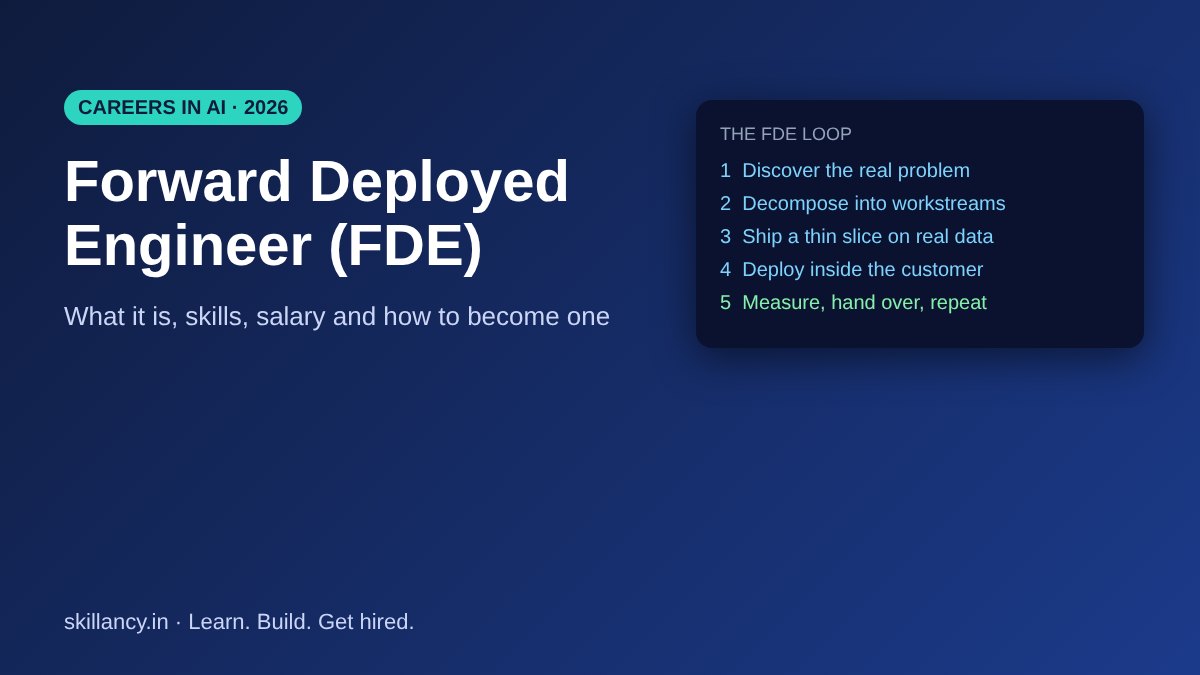
A forward deployed engineer, usually shortened to FDE, is a software engineer who works inside a customer's organisation to get a product running in production and keep it running. The role started at Palantir about two decades ago and has become one of the most talked-about jobs in AI, because most companies discover the same thing: the model is rarely the hard part, getting it to work inside a real business is. This guide explains what an FDE is, how the role differs from a software engineer, solutions engineer, consultant and data analyst, who hires them, what they earn, 15 realistic scenarios from the job, a hands-on example with real outputs, a 12-week plan to become one, and how the interviews work.
| Question | Short answer |
|---|---|
| What does an FDE do? | Builds and deploys software inside a customer's environment and owns the result |
| Where did the role start? | Palantir, where these engineers were called Deltas |
| Is it only for software engineers? | No, strong data analysts and data engineers move into it |
| What is the hardest part? | Messy data and undocumented workflows, not the model |
| How is it hired? | Coding, system design, an open-ended decomposition case and a client role-play |
What is a forward deployed engineer?
A forward deployed engineer is a technical specialist embedded with a customer to scope, build and deploy a solution end to end. The word "forward" comes from military usage: you are deployed forward, close to where the problem is, instead of working from headquarters. In practice an FDE joins the customer's team, works with their data and their people, writes production code, and stays involved after launch to fix what breaks and improve what works.
Three ideas separate the role from similar jobs:
- Production code, not demos. The work runs on the customer's real data and systems.
- Outcome ownership. Success is measured by whether the system is used and delivers a result, not by whether it shipped.
- A feedback loop to the product. What the FDE learns in the field goes back to the company's core product team.
Where the role came from
The model began at Palantir, which sells data-integration software to government agencies and large enterprises. Around 2006 the company found that powerful software was not enough: customers could not operationalise it on their own. Palantir started sending engineers into customer organisations to build the workflows directly. Internally these engineers were called Deltas. According to reporting by The New Stack, Palantir had more of them than product engineers until 2016.
Palantir's own engineering blog describes the split clearly. Devs build and maintain the core platforms and think in terms of "one capability, many customers." Deltas deploy those platforms to individual customers and judge success by the impact on that customer's goals. A Delta is not a consultant: a consultant typically delivers a one-time analysis or recommendation, while a Delta does much more hands-on engineering and builds solutions the customer can keep improving. When a missing feature blocks a customer, Deltas sometimes contribute code back to the core product, and moving between the two roles is common.
One more Palantir term is worth knowing. Deltas were paired with Echoes, who handle the people side: adoption, organisational politics and executive alignment. Many AI companies today ask a single FDE to cover both.
A day in the life
| Time | What an FDE might be doing |
|---|---|
| Morning | Stand-up with the customer's team, review overnight pipeline failures |
| Late morning | Trace why a model output looks wrong: a bad join, a stale table, a changed field |
| Afternoon | Build or fix an integration, write a small script or API, add tests |
| Late afternoon | Walk a non-technical manager through a result and agree the next priority |
| End of day | Log what broke and what the product is missing, and send it to the product team |
The split between coding and talking to people varies by company, but one industry guide describes roughly half the role as customer-facing. If you want a job that is purely heads-down coding, this is probably not it.
FDE vs solutions engineer, software engineer, consultant and data analyst
The title is easy to confuse with several neighbouring roles. The cleanest test is to ask two questions: who writes the production code, and who owns the result after launch?
| Role | Main focus | How it differs from an FDE |
|---|---|---|
| Solutions or sales engineer | Demos, proofs of concept, pre-sales architecture | Work usually ends when the customer signs; an FDE's starts there |
| Management consultant | Analysis, strategy, recommendations | Delivers decks and advice, not running code or owned outcomes |
| Professional services or system integrator | Implementation to a fixed statement of work | Fixed scope, versus an open-ended, embedded, outcome-accountable role |
| Customer or developer-relations engineer | Docs, content and support for many users | Broad but shallow, versus deep work in one customer's production system |
| Product software engineer | Builds one capability for many customers | An FDE applies the product to one customer's messy reality |
| Data analyst | Answers business questions with data | An FDE builds and deploys the systems that run on that data |
Where data analysts fit
Analysts are often better positioned for this role than they expect. The hardest FDE problems are data problems: duplicate IDs, fields that changed meaning, tables that disagree, and metrics nobody defined. An analyst who is already good at checking joins, reconciling totals and explaining numbers to business teams has a head start. What most analysts need to add is production engineering: writing tested code, building APIs and pipelines, working with cloud services, and deploying systems other people depend on.
| Skill | Typical analyst today | What an FDE needs |
|---|---|---|
| SQL | Strong | Strong, plus performance and data modelling |
| Python | Scripts and notebooks | Tested, packaged, production-grade code |
| Data quality | Spot-checks results | Builds validation into the pipeline |
| Communication | Presents findings | Negotiates scope and pushes back on risky requests |
| Ownership | Delivers reports | Owns uptime, adoption and outcomes |
| AI tools | Uses assistants | Builds and evaluates AI systems (retrieval, agents, evals) |
Who hires forward deployed engineers, and why demand is rising
FDE hiring is concentrated in AI and data platform companies, but the title is spreading. A job-board snapshot from JobsByCulture counted 224 open FDE roles, with the largest numbers at Palantir (51), OpenAI (31), Databricks (12), Mistral (11), Cohere (10) and Cresta (10), plus Scale AI, Snowflake, Stripe, Cloudflare and others. Treat that as a point-in-time count from one site, not a market census. The New Stack reports that OpenAI set up its forward deployed engineering team in 2024 and grew it quickly, and that Anthropic has announced plans to grow its Applied AI group.
| Signal | What is reported | Source and caveat |
|---|---|---|
| Job postings | More than 800% growth between January and September 2025 | Reported by The New Stack and JobsByCulture from unnamed industry tracking; treat as directional |
| Pilot failure rate | 95% of enterprise AI pilots showed little or no measurable P&L impact | MIT NANDA study of 300 public AI projects, as cited by The New Stack |
| Palantir's model | More Deltas than product engineers until 2016 | The New Stack |
| Seniority | Few early-career openings; most roles ask for experience | One industry census put early-career roles at about 3%; verify before quoting |
Why the role exists
The argument usually made for the role is simple. AI systems are probabilistic: a model can pass testing and then drift on real production data, often without failing loudly. Internal teams are built to ship features, and consultants work to fixed scopes, so ownership fades exactly when an AI system needs the most hands-on attention. An engineer embedded with the customer shortens the feedback loop. As one FDE quoted by The New Stack put it, the model is usually the cleanest part; the hard part is finding the workflow nobody documented.
What this means for you
- The role rewards people who are comfortable with ambiguity and with customers.
- Most openings ask for real engineering experience, so build proof of work before applying.
- The title appears in many forms: forward deployed engineer, forward deployed AI engineer, applied AI engineer, deployment engineer, customer engineer (technical). Search for all of them.
FDE skills and tools: what you actually need
FDE job descriptions look long, but they cluster into four groups. You do not need to be an expert in all of them on day one; you need a strong base and the ability to learn the customer's stack quickly.
| Skill group | What it includes | Tools you will see |
|---|---|---|
| Core engineering | Production Python, often TypeScript or Java, APIs, testing, Git, debugging in unfamiliar codebases | Python, FastAPI, REST, Docker, Git, CI |
| Data | SQL, data modelling, ETL and ELT, data quality, reconciling sources | PostgreSQL, Snowflake, Databricks, dbt, Airflow, pandas |
| AI systems | Retrieval-augmented generation, prompt design, evaluation, agents, observability | LLM APIs, vector databases, eval harnesses, tracing tools |
| Deployment and cloud | Authentication, networking basics, security and access, monitoring, rollback | AWS, Azure or GCP, Kubernetes basics, logging and alerting |
| Customer skills | Scoping, stakeholder management, writing, pushing back, explaining trade-offs | Documents, whiteboards, clear status updates |
The skill that decides most careers: decomposition
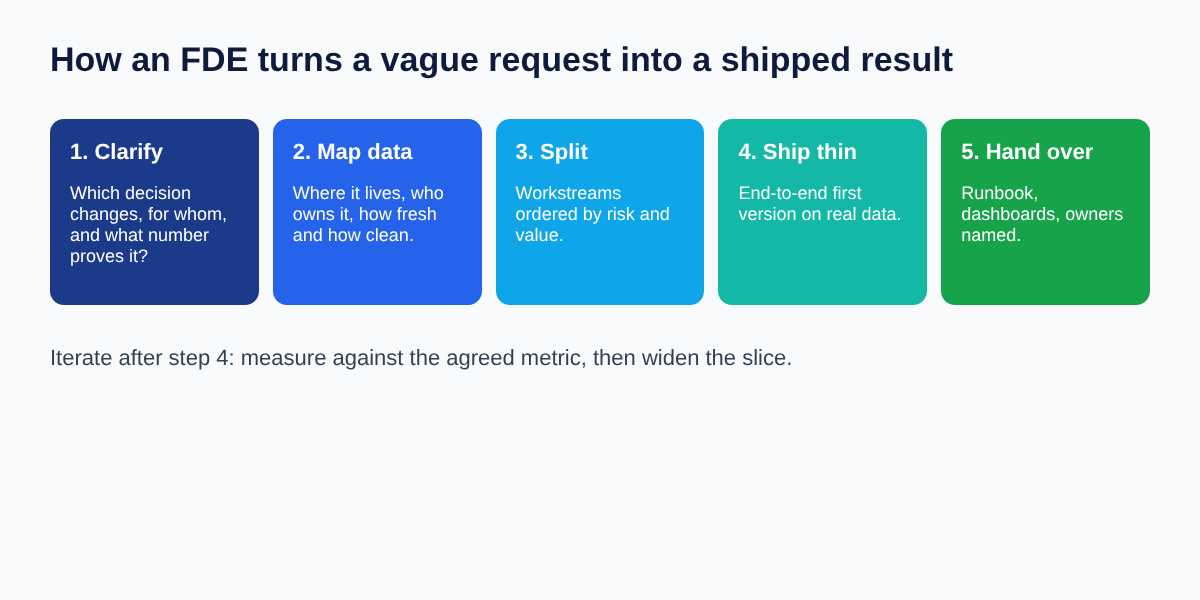
FDEs are routinely handed a large, vague problem, such as "reduce emergency response times" or "unify fraud detection across three systems." The ability to break that into workstreams, find the riskiest assumption, and ship a thin end-to-end first version is the single most valued skill, and it is what the interview loop tests hardest.
A practical order of operations:
1. Clarify the goal. What decision or number should change, and for whom?
2. Name the stakeholders and the success metric. Who uses it, and how will you know it worked?
3. Map the data. Where does it live, who owns it, how fresh is it, how clean is it?
4. Split into workstreams and sequence them by risk and value.
5. Ship a thin slice end to end, then iterate.
Soft skills that are really hard skills
- Saying no with options. "We can't do that safely this week, but we can do A now and B next sprint."
- Writing. Short, clear updates are how a customer's executives decide whether to trust you.
- Owning mistakes early. Surface a slipped deadline before the customer finds it.
15 real forward deployed engineer scenarios (and how to handle them)
These are composite scenarios based on the patterns described in the sources at the end of this post. Each one follows the same shape: what the customer sees, what is actually happening, and what a good FDE does next.
| # | Theme | The core lesson |
|---|---|---|
| 1 | Vague mandate | Turn a slogan into a measurable decision |
| 2 | Dirty data | Profile before you build |
| 3 | Pilot that never ships | Design for production from day one |
| 4 | Hallucinating assistant | Evaluation beats opinion |
| 5 | Access blocked by security | Ask for least privilege early |
| 6 | Champion leaves | Build more than one sponsor |
| 7 | Scope creep | Say no with options |
| 8 | Legacy system | Wrap, do not rewrite |
| 9 | Latency complaints | Measure where time goes |
| 10 | Cost overrun | Put a budget on every call |
| 11 | Wrong success metric | Agree the number before the build |
| 12 | Users ignore the tool | Fit the workflow, not the demo |
| 13 | Privacy and compliance | Data residency is a design input |
| 14 | Product gap | Feed it back, do not fork |
| 15 | Handover | Leave the customer able to run it |
1. The vague mandate
The scenario: A logistics VP says, "We want AI to cut delivery delays."
What is really going on: There is a goal but no decision. Delays have many causes: routing, loading, weather, driver shortages.
How to handle it: Ask which decision a person makes today that a model could improve, such as re-routing a truck at 2 p.m. Pick one lane, one metric (on-time percentage), and a baseline you can measure this week.
2. The dirty data
The scenario: Customer IDs are C001 in the CRM and c001 (lowercase, trailing space) in the order system. A naive join silently drops rows.
What is really going on: Nothing is broken in either system. They were built by different teams with different conventions.
How to handle it: Profile first, normalise keys, join with a validation (many_to_one), and reconcile totals before and after. The hands-on section below does exactly this with real output.
3. The pilot that never ships
The scenario: A demo impressed everyone, then stalled for four months.
What is really going on: The demo ran on a laptop with a CSV export. Nobody owns the production data feed, the access review or the on-call rota.
How to handle it: Name the production owner in week one. Build the thinnest version that runs on real data in the customer's environment, even if it is ugly.
4. The hallucinating assistant
The scenario: An internal policy bot confidently quotes a rule that does not exist.
What is really going on: Retrieval returned weak context, or the question was out of scope and nothing told the model to refuse.
How to handle it: Build a small evaluation set of real questions with expected answers, measure before and after every change, add a "say I don't know" path, and show citations in the UI.
5. Security blocks access
The scenario: The customer's security team has not approved access to the data warehouse, two weeks into the engagement.
What is really going on: Access requests were filed late and asked for too much.
How to handle it: Request least-privilege, read-only access to a specific schema in the first week, and offer a sample or masked extract so work continues while approval is pending.
6. The champion leaves
The scenario: Your main sponsor changes jobs and priorities shift.
What is really going on: The project depended on one person's goodwill.
How to handle it: Keep a short weekly note to three stakeholders, tie the work to a metric their leadership already tracks, and introduce yourself to the new owner quickly.
7. Scope creep
The scenario: "While you're here, can you also build the dashboard, the alerts and the mobile app?"
What is really going on: Success breeds requests, and the customer cannot see the cost.
How to handle it: Write requests down, rank them against the agreed metric, and respond with "Yes, after X, and here is what moves."
8. The legacy system
The scenario: The system of record is a 20-year-old mainframe with a nightly batch export.
What is really going on: Rewriting it is out of scope and out of budget.
How to handle it: Wrap it. Read the nightly export, build a clean interface on top, and design so that a later migration only changes the adapter.
9. The latency complaint
The scenario: Users say the assistant is slow.
What is really going on: It could be retrieval, the model call, a cold start, or an unrelated network hop.
How to handle it: Add tracing, measure each stage, and fix the biggest slice first. Cache what repeats, stream partial answers, and use a smaller model where quality allows.
10. The cost overrun
The scenario: The monthly model bill is three times the estimate.
What is really going on: Long prompts, retries and an unbounded agent loop.
How to handle it: Log tokens per request, set per-request and per-user budgets, cap loop depth, and route easy cases to cheaper models.
11. The wrong success metric
The scenario: The team celebrates "tickets handled by AI," but customer satisfaction is falling.
What is really going on: The metric rewards volume, not resolution.
How to handle it: Agree on the outcome metric (first-contact resolution, satisfaction, handling time with quality checks) before building, and report it weekly.
12. Users ignore the tool
The scenario: Adoption is 5% after launch.
What is really going on: The tool lives in a separate tab, while the work happens in another system.
How to handle it: Shadow three users for a day. Embed the feature where they already work, remove one step rather than adding one, and recruit a power user as an advocate.
13. Privacy and compliance
The scenario: The data contains personal information and must stay in the customer's region.
What is really going on: Residency and retention rules are architecture constraints, not paperwork.
How to handle it: Ask in week one, choose deployment (customer cloud, private endpoint or on-premises) accordingly, mask what the model does not need, and log access.
14. The product gap
The scenario: The customer needs a feature your company's product does not have.
What is really going on: Either this is a one-off, or it is the early signal of a real product need.
How to handle it: Build a clean workaround, document the pattern, and send it to the product team with evidence. Avoid forking the product for one customer.
15. The handover
The scenario: The engagement is ending and the customer team has never run the system alone.
What is really going on: Success is judged by whether it keeps working after you leave.
How to handle it: Write a short runbook, hold a shadow-reverse-shadow handover (you do it, they do it with you watching, they do it alone), and leave dashboards and alerts they own.
Learn it live: Data cleaning, joins and reconciliation (scenarios 2 and 11) are core Data Analytics skills. Practise on real messy datasets in our Data Analytics with Agentic AI program.
Hands-on: reconcile two systems the way an FDE would
Scenario 2 above is the most common first-week task: two systems describe the same customers, the keys do not match, and someone wants one trustworthy number. Here is a small, runnable version. Every output below was produced by running this exact script with pandas.
The data
A CRM extract (5 rows, one duplicated customer, one missing city) and an ERP order extract (5 rows, a lowercase key, a key with a trailing space, an unknown customer and a missing amount).
The code
import pandas as pd, io

crm = pd.read_csv(io.StringIO("""customer_id,name,city,email
C001,Asha Traders,Pune,asha@x.in
C002,Bharat Foods,Mumbai,bharat@x.in
C003,Cedar Logistics,Delhi,cedar@x.in
C003,Cedar Logistics Pvt Ltd,Delhi,cedar@x.in
C004,Dev Retail,,dev@x.in
"""))

erp = pd.read_csv(io.StringIO("""cust_code,order_id,amount,order_date
c001,5001,1200,2026-09-01
C002 ,5002,800,2026-09-03
C003,5003,1500,2026-09-05
C005,5004,400,2026-09-07
C001,5005,,2026-09-09
"""))

# 1. Profile before you build
print("crm rows:", len(crm), "| unique ids:", crm.customer_id.nunique())
print("erp rows:", len(erp), "| missing amounts:", int(erp.amount.isna().sum()))

# 2. Naive join on raw keys
naive = erp.merge(crm, left_on="cust_code", right_on="customer_id", how="left")
print("rows:", len(naive), "| matched:", int(naive.customer_id.notna().sum()),
      "| total amount:", naive.amount.sum())

# 3. Normalise keys, de-duplicate the dimension, join with a guard
erp["cust_code"] = erp.cust_code.str.strip().str.upper()
crm_u = crm.drop_duplicates("customer_id", keep="first")
fixed = erp.merge(crm_u, left_on="cust_code", right_on="customer_id",
                  how="left", validate="many_to_one")
print("rows:", len(fixed), "| matched:", int(fixed.customer_id.notna().sum()),
      "| total amount:", fixed.amount.sum())

# 4. Validation report
print("orders with no customer:", fixed.loc[fixed.customer_id.isna(), "order_id"].tolist())
print("orders with missing amount:", fixed.loc[fixed.amount.isna(), "order_id"].tolist())
print("customers with no city:", crm_u.loc[crm_u.city.isna(), "customer_id"].tolist())
print("source total:", erp.amount.sum(), "| joined total:", fixed.amount.sum(),
      "| reconciles:", erp.amount.sum() == fixed.amount.sum())
The real output
== 1. Profile the inputs
crm rows: 5 | unique ids: 4
erp rows: 5 | missing amounts: 1
== 2. Naive join on raw keys
rows: 6 | matched: 3 | total amount: 5400.0
== 3. Normalise keys, then join
rows: 5 | matched: 4 | total amount: 3900.0
== 4. Validation report
orders with no customer: [5004]
orders with missing amount: [5005]
customers with no city: ['C004']
source total: 3900.0 | joined total: 3900.0 | reconciles: True
What the output teaches
| Step | Result | What it means |
|---|---|---|
| Profile | 5 CRM rows but only 4 unique IDs | The customer table has a duplicate, which will multiply order rows |
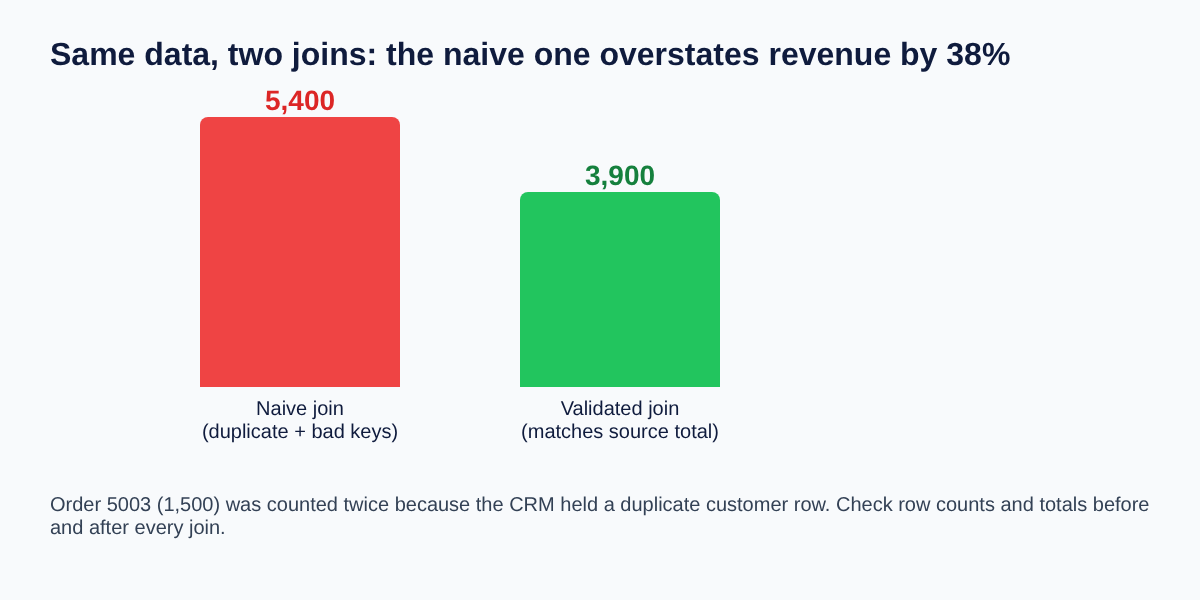
| Naive join | 6 rows from 5 orders, total 5,400 | The duplicate inflated revenue by 1,500 (order 5003 counted twice) |
| Naive join | Only 3 of 6 rows matched | Case and whitespace in the keys hid real matches |
| Fixed join | 5 rows, 4 matched, total 3,900 | Row count and total now equal the source |
| Validation | One unknown customer, one missing amount | These are questions for the customer, not things to quietly fill in |
The naive version looks like it worked: no error, a plausible total. It overstated revenue by about 38 percent (5,400 against 3,900). This is exactly the silent failure customers do not see and FDEs are hired to catch. Two habits did the work: a row-count and total check before and after every join, and validate="many_to_one", which would have raised an error on the duplicate instead of letting it through.
Learn it live: Joins, deduplication and reconciliation checks are practised daily in our SQL practice questions and Python practice questions. Try the same exercise in the Python compiler.
Forward deployed engineer salary and career path (India and global)
Salary data for a role this new is noisy. The figures below come from market guides and salary aggregators, not from audited surveys, and the ranges are wide because pay depends heavily on employer type (AI lab, data platform, services firm or startup), equity, and whether the role is based in India or abroad. Treat them as a planning range, then check live postings and Glassdoor-style data for your target employers.
| Level | India (estimated, per year) | US (estimated, total compensation) | Europe (estimated) |
|---|---|---|---|
| Junior (0-3 years) | ₹18-25 LPA | Lower end of the US range | Lower end of the European range |
| Mid (3-7 years) | ₹30-65 LPA (one guide's own FAQ says ₹30-55 LPA) | Mid-range | Mid-range |
| Senior (7+ years) | ₹65 LPA to ₹1.2 Cr+ | Upper range | Upper range |
| Whole-market range | n/a | $160K-$550K+ | €85K-€180K |
Source: Scaler's FDE salary guide, a training company with a commercial interest in the topic. Its India and global ranges are estimates and its two India figures for mid-level do not agree, so use the ranges loosely.
Why pay varies so much
| Factor | Effect on pay |
|---|---|
| Employer type | AI labs and data platforms with large enterprise contracts pay at the top; services firms pay closer to software-engineer bands |
| Equity | At private AI companies, equity can be a large share of total compensation, with real risk attached |
| Location | US roles pay several times India roles; remote-from-India roles often sit in between |
| Seniority of customers | Working with executives and regulated industries commands a premium |
| Travel | Heavy on-site travel is often compensated through allowances or higher base |
Where the role leads
There is no single ladder yet, but these paths appear repeatedly:
1. Senior and lead FDE. Larger accounts, mentoring, owning delivery for a region or vertical.
2. Engineering manager, deployment. Running a team of FDEs and setting the engagement playbook.
3. Product. Years of customer exposure make FDEs credible product managers, especially for enterprise AI products.
4. Solutions architecture or technical leadership. Designing larger programmes across several customers.
5. Founder. Many founders of enterprise AI start-ups spent time deep inside customers' problems first.
Is the role stable?
Two honest notes. First, demand is real but young: published counts of open roles are snapshots, and the largest share sits at a handful of companies, so the market is less deep than for general software engineering. Second, early-career openings are rare. One tracker put them at roughly 3 percent of postings, so most people reach FDE after a few years as a data analyst, data engineer, software engineer or consultant. That is why the roadmap in the next section starts from a strong base role rather than treating FDE as a first job.
Learn it live: If you are an analyst today, our Data Analytics with Agentic AI program and Data Science with AI program build the data and AI foundation that FDE hiring teams look for.
How to become a forward deployed engineer: roadmap, 12-week plan and portfolio
Pick your starting point
| If you are today | Your advantage | Your gap to close |
|---|---|---|
| Data analyst | SQL, business context, stakeholder habits | Production code, APIs, deployment, LLM systems |
| Software engineer | Shipping, testing, systems | Data depth, customer-facing communication |
| Data engineer | Pipelines, data quality, cloud | Customer discovery, AI application layer |
| Consultant or solutions engineer | Customer trust, scoping | Hands-on engineering depth |
| Fresher | Time to learn, no baggage | Proof of work, since early-career roles are scarce |
A 12-week plan
This assumes about 8-10 hours a week and a working knowledge of SQL and basic Python. Adjust to your pace.
| Weeks | Focus | Output you should have |
|---|---|---|
| 1-2 | Python for production: functions, tests, packaging, reading unfamiliar code | A small tested package on GitHub |
| 3-4 | Data wrangling at scale: messy CSV and JSON, joins, validation, reconciliation | A cleaning pipeline with before-and-after checks (like the hands-on example) |
| 5-6 | APIs: build one with FastAPI, call others, handle auth, retries and backoff with jitter | A deployed API with logging |
| 7-8 | LLM applications: retrieval-augmented generation over a real document set, with an evaluation set | A working RAG app and a written evaluation of its accuracy |
| 9-10 | Deploy and operate: containers, a cloud host, monitoring, cost tracking | A live app with a dashboard of latency and cost |
| 11 | Customer simulation: pick a messy business problem, write a one-page scope, decompose it | A scope document and plan |
| 12 | Package it all: README, short demo video, write-up of trade-offs | A portfolio ready to share |
What a strong FDE portfolio looks like
Hiring teams care more about evidence of end-to-end ownership than about volume. Three projects beat ten.
1. A messy-data project. Real public data, cleaned and reconciled, with the checks shown.
2. An AI application with an evaluation. Not just a demo: a test set, a measured accuracy, and a note on failure cases.
3. A deployed system with a write-up. A live link, monitoring, cost per request, and a plain-English summary a non-engineer could read.
For each, include the business problem in one sentence, the decision it supports, and what you would do differently. That last line signals judgment.
Routes in if you do not have the title yet
- Move sideways inside your company. Ask to join customer-facing technical projects or implementations.
- Target adjacent roles. Solutions engineer, implementation engineer, data engineer and analytics engineer roles all build the same muscles.
- Apply to growth-stage companies. They often hire for ability to learn quickly and hire less on exact title match.
- Show your thinking in public. A short write-up on how you would decompose a customer problem is a strong signal.
Learn it live: Follow a structured path with mentors in our Data Analytics with Agentic AI program. Start with SQL fundamentals and practise in the SQL compiler.
The FDE interview: process, questions and a sample answer
FDE loops are longer and more varied than most software interviews. One 2026 guide describes a typical process of five to eight stages over three to six weeks. Companies differ, so use this as a map, not a promise.
| Stage | What it tests | How to prepare |
|---|---|---|
| Recruiter screen | Motivation, location, basics of the role | A crisp "why FDE" story |
| Hiring manager screen | Customer-facing experience, past impact | Two or three projects told with outcomes |
| Coding | Practical Python: messy CSV or JSON, rate limiter, retry with backoff and jitter, a small RAG | Write clean code with tests under time |
| System design | Architecture for a realistic case, such as a private RAG system for a hospital | Cover data, security, evaluation and rollout, not only models |
| Decomposition case | Breaking a vague problem into workstreams. This is the stage that filters most candidates | Practise the five-step framework from the skills section |
| Client simulation | Communication, pushing back, handling a difficult stakeholder | Role-play with a friend; practise saying no with options |
| Behavioural | Ownership, conflict, failure | Prepare six to eight STAR stories |
| Take-home | End-to-end build, often four to eight hours | Keep scope small, write a README, show trade-offs |
Sample questions
| Type | Example question | What a good answer shows |
|---|---|---|
| Decomposition | "A hospital wants AI to reduce missed appointments. How do you start?" | Clarifying questions, a metric, data mapping, a thin first version |
| Coding | "Merge two customer files with inconsistent IDs and report what you could not match." | Normalisation, join validation, a reconciliation report |
| System design | "Design a private question-answering system over contracts." | Retrieval, access control, evaluation, cost, audit logs |
| Client simulation | "Your sponsor wants a feature that will take three months. You have two weeks." | A calm no, with options and a recommendation |
| Behavioural | "Tell me about a project that failed." | Ownership, what you changed, no blame |
| AI judgment | "The model's answers look good in a demo. How do you know it is ready?" | An evaluation set, failure analysis, monitoring |
Sample answer: decomposition
Question: "A hospital wants AI to reduce missed appointments. How would you approach it?"
I would start with the decision, not the model. Who acts on this, and what do they do differently? If a scheduler can call high-risk patients two days ahead, then I need a list ranked by risk that fits their workflow.
Next I would agree the metric: no-show rate for the targeted clinics, with a baseline from the last six months, plus a guardrail so we do not overbook.
Then I would map the data: appointment history, patient contact details, and any reminder logs. I would check quality early, because a missing phone number makes a perfect model useless.
I would split the work into three streams: a clean data feed, a simple prediction or rules baseline, and the outreach workflow. The first version would be a rules-based list for one clinic, shipped within two weeks, so we learn quickly.
Finally I would agree who owns it after launch, how privacy rules apply, and what we measure each week. I would only add a more complex model if the baseline leaves clear room to improve.
Notice what it does: it starts from the decision, names a metric and baseline, surfaces data and privacy risk, and ships a thin version first. That structure, not the specific hospital details, is what interviewers listen for.
Practise before the real loop
The fastest way to improve at decomposition and client simulation is to do them out loud with feedback. You can book a mock interview with Skillancy, and warm up on SQL interview questions and Python interview questions.
Learn it live: Get structured feedback on your decomposition and communication in a Skillancy mock interview.
Common mistakes aspiring FDEs make
| Mistake | Why it hurts | Do this instead |
|---|---|---|
| Treating FDE as a prompt-engineering job | The hard parts are data, integration and deployment | Build and deploy a full system, not a demo |
| Skipping evaluation | You cannot say whether the system works | Create a test set and track accuracy |
| Ignoring the customer's constraints | Security, residency and workflow decide success | Ask about them in week one |
| Over-building the first version | Slow feedback and wasted effort | Ship a thin end-to-end slice |
| Saying yes to everything | Scope creep and missed deadlines | Say no with options |
| Hiding bad news | Trust collapses when it surfaces late | Flag slips early with a plan |
| Applying with no proof of work | Early-career roles are scarce | Show three strong projects |
Frequently asked questions
What does a forward deployed engineer do?
A forward deployed engineer works directly with a customer to turn their messy, real-world problem into working software. That means scoping the problem, connecting to their data, building and deploying a solution inside their environment, and staying until it is used.
Is a forward deployed engineer the same as a solutions engineer?
No. Solutions engineers usually support the sales process with demos, proofs of concept and technical advice. Forward deployed engineers build and own production-grade solutions for a specific customer and often write substantial code in the customer's environment.
Can a data analyst become a forward deployed engineer?
Yes, but it usually takes a deliberate step up in engineering. Analysts already have SQL, business context and stakeholder skills. The gaps are production Python, APIs, deployment and building AI systems, which the 12-week plan above is designed to close.
Which companies hire forward deployed engineers?
Palantir created the role and still lists the most openings. AI labs such as OpenAI and Anthropic, and data and AI platform companies such as Databricks, Mistral, Cohere and Cresta, also hire for it. A snapshot of 224 roles in 2026 showed Palantir with 51 and OpenAI with 31.
How much does a forward deployed engineer earn in India?
Market guides estimate roughly ₹18-25 LPA at junior level, ₹30-65 LPA at mid level and ₹65 LPA to ₹1.2 crore or more at senior level. These are estimates from secondary sources and vary a lot by employer and equity, so check live postings.
Do I need a computer science degree to become an FDE?
Not strictly. Employers look for engineering ability, data skills and customer judgment. A degree helps, but a strong portfolio of deployed projects and relevant work experience can carry equal weight.
Is the forward deployed engineer role a good career in 2026?
It is a strong option if you like customer-facing technical work, with growing demand as companies struggle to turn AI pilots into results. The trade-offs are travel, ambiguity and fewer entry-level openings than general software roles.
How long does it take to become a forward deployed engineer?
If you already work as an analyst or engineer, a focused 12 weeks can build a credible portfolio, but moving into the role often takes six to twelve months of applications and interviews. Starting from scratch typically takes longer, because most hires have prior experience.
Recommended reading and practice on Skillancy
- Correlation vs causation: a core analytical habit for any customer-facing data role
- Data analyst interview questions
- Data analyst interviews with AI in 2026
- Python for data science
- SQL practice questions and Python practice questions
- Mock interviews
- Data Analytics with Agentic AI and Data Science with AI
Sources
- Palantir, "Dev versus Delta: demystifying engineering roles at Palantir"
- The New Stack, forward deployed engineers and AI
- JobsByCulture, "Forward deployed engineer boom 2026"
- Plank, "Forward deployed engineer"
- Scaler, FDE salary, roles and responsibilities
- University of Kentucky Career Center, "Forward deployed engineer interview: the definitive 2026 guide"
Some figures (posting growth, role counts, salary ranges) come from secondary sources that do not publish their methods, and are labelled as estimates in the text.
Reproducibility note
The code in the hands-on section was run with Python 3 and pandas on 24 October 2026, and the outputs shown are copied from that run. The 15 scenarios are composites written to illustrate patterns described in the sources, not accounts of specific customers.
Learn it live: Ready to build the skills behind this role? Explore Data Analytics with Agentic AI, or book a mock interview. Learn. Build. Get hired.
Get the Skillancy field notes
One email a week: AI and analytics guides, cohort dates and hiring signals. No spam, unsubscribe anytime.