
AI Agents in Supply Chain and Logistics (2026): Use Cases, Guardrails and a Working Demo
By Skillancy Editorial Team · 5 November 2026 · 26 min read
Reviewed by Rishav Kumar, Principal Data Analyst, Walmart Global Tech
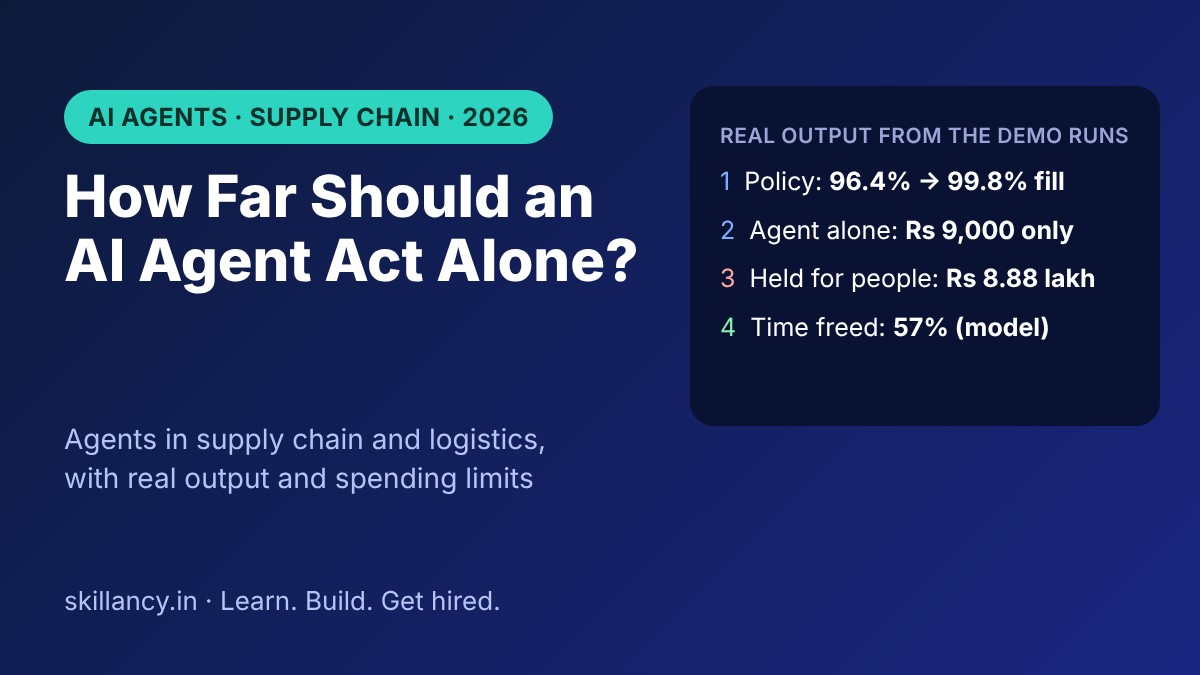
Every supply chain team knows the feeling of a Monday morning exception queue: 140 late shipments, a handful of stock-outs, three supplier emails and a dashboard that is already out of date. Most of those exceptions are routine, and a few are expensive. The hard part is telling them apart quickly enough to act. AI agents are the first technology that can do part of that sorting and acting for you, because they can read signals from your systems, plan a few steps, call tools such as your ERP, TMS or a routing engine, check their own work and hand the difficult cases to a planner. This guide explains what AI agents in supply chain and logistics actually are, where they work today, where they should not be trusted, and how to build a small, safe version yourself, with two runnable demos, a time-saved calculation, an India-specific section and a 30-60-90 day plan.
| Question | Short answer |
|---|---|
| What is an AI agent in supply chain? | Software that senses a situation, chooses an action, uses tools to carry it out and checks the result, within limits you set |
| How is it different from a forecasting model? | A model predicts. An agent predicts, then does something about it: raises a PO, re-routes a load, emails a supplier |
| Where does it work best today? | Exception handling, replenishment support, supplier follow-up, invoice matching, warehouse task coordination |
| Where is it risky? | Large spend, safety-critical decisions, anything irreversible, and anything built on dirty master data |
| What makes it safe? | Tiered authority, rupee limits, confidence thresholds, input checks, logs and a human approval path |
| Will it replace planners? | It replaces tasks, not the role. Planners shift from firefighting to setting policy and handling exceptions that matter |
| Where do I start? | One exception type, read-only access, recommendations only, then widen authority as trust grows |
What is an AI agent in supply chain and logistics?
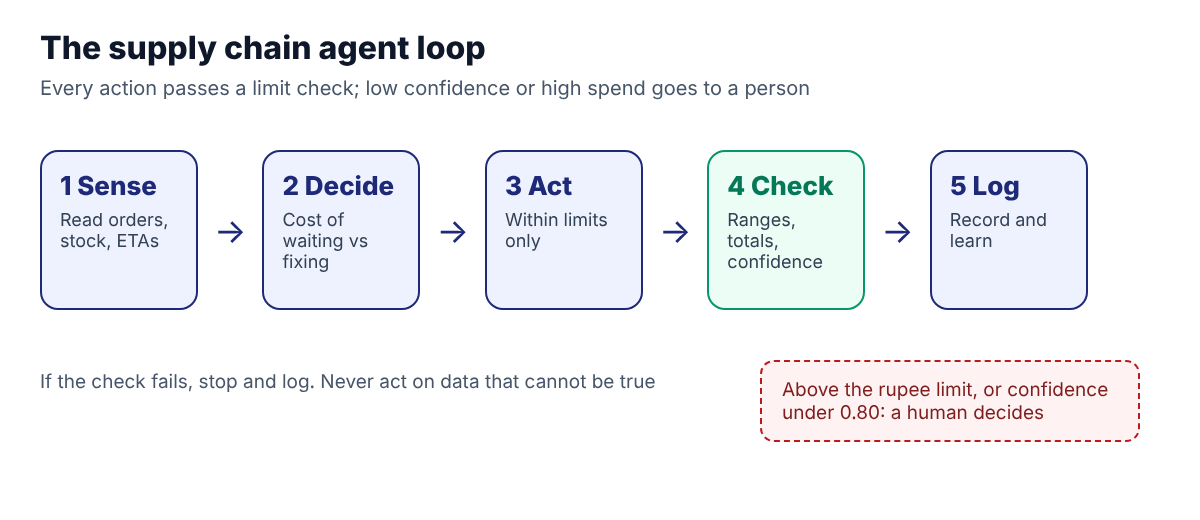
An AI agent in a supply chain context is a system that works toward a goal, such as "keep service level above 98% on this lane" or "resolve late-shipment exceptions before they breach the SLA", by running a loop rather than answering a single question. It observes data from your systems, decides what to do, acts through a tool, checks whether the action worked and escalates to a person when the situation is outside its limits.
Three things separate an agent from the tools most supply chain teams already run:
1. A forecasting or optimisation model gives you a number or a plan. It does not read the exception inbox, email the carrier or update the order.
2. A rules engine or RPA bot follows a fixed script. When the input changes shape, it breaks or does the wrong thing quietly.
3. A chat assistant answers questions about data you paste in. It does not watch your systems or take action on its own.
An agent can use all three as tools. A demand forecast, a routing solver and a rules check are often called by the agent. The agent is the coordinator that decides which to call, in what order, and what to do with the result. The same pattern, including the check step and the approval gate, is covered for analytics work in our guide to agentic AI in everyday analytics.
Industry analysts describe adoption as early but moving. Gartner's April 2026 press release forecasts that spending on supply chain management software with agentic AI capabilities will grow from under $2 billion in 2025 to $53 billion by 2030, and that 60% of enterprises using such software will have adopted agentic features by 2030, up from 5% in 2025. The same release says enterprise deployment is expected to lag vendors' product launches, because the surrounding operating model (data, processes, people) is not ready. That gap is where practitioners earn their value.
The supply chain agent ladder: how much authority should an agent have?
The most useful design decision is not which model to use. It is how much the agent is allowed to do alone. Treat authority as a ladder and move up one rung at a time.
| Level | What the agent may do | Example in logistics | Risk |
|---|---|---|---|
| 1. Read | Watch data and summarise it | "These 11 shipments are tracking late" | Very low |
| 2. Recommend | Propose an action with reasons | "Expedite SH-1002 for Rs 1.4 lakh; net saving Rs 55,000" | Low |
| 3. Draft | Prepare the email, PO or booking, unsent | Draft a carrier escalation email for a planner to send | Low to medium |
| 4. Execute within limits | Act alone below a rupee limit and above a confidence level | Auto-book a Rs 9,000 expedite | Medium |
| 5. Execute broadly | Act with minimal oversight | Rarely justified today | High |
Most teams should live at levels 1 to 3 for their first quarter, and use level 4 only for small, reversible actions with strong checks. Gartner's own framing is similar in spirit: it expects organisations to measure value from simple agents that execute discrete tasks over the next 12 to 18 months, rather than hand over whole processes.
Learn it live: Want to design and build agent workflows like this on real data, with a mentor? Explore Data Analytics with Agentic AI, or talk to a mentor.
Where AI agents work in supply chain and logistics
Not every part of the chain is equally ready. This table summarises where agents fit today, what they do, and how much authority is sensible.
| Area | What the agent does | Suggested authority today | Main failure risk |
|---|---|---|---|
| Demand and inventory | Watches stock against reorder points, flags risk, drafts replenishment orders | Recommend, then draft | Bad forecasts or stale stock data |
| Exception management / control tower | Detects late or damaged shipments, estimates cost of delay, proposes or books a fix | Recommend; execute only small actions | Acting on wrong ETAs |
| Procurement and suppliers | Chases confirmations, compares quotes, drafts POs | Draft; human approves | Wrong supplier terms or pricing |
| Warehouse operations | Coordinates picking waves, dock slots and labour allocation | Recommend; limited execute | Local optimisation that hurts flow elsewhere |
| Transport and last mile | Re-plans routes, rebooks carriers, updates customers | Recommend; execute within limits | Cascading effects of a re-route |
| Freight audit and invoicing | Matches invoices to PO, POD and rate card, flags mismatches | Execute matches; humans handle disputes | Over-trusting messy documents |
| Planning and what-if | Runs scenarios, explains trade-offs in plain language | Read and recommend | Confident but unchecked scenarios |
1. Demand, inventory and replenishment
The classic problem is deciding when to reorder and how much buffer to hold. A planner knows that average demand is not enough, because demand varies and so does supplier lead time. An agent can check each SKU daily against its reorder point, notice that lead times on a supplier have been getting longer, and propose a higher buffer with a draft order. It should not set the policy itself. Demo 1 below shows why the policy matters more than the agent.
2. Exception management and the control tower
A control tower is a single view of orders, inventory and shipments. An agent turns it from something people watch into something that watches for them. For each exception it can estimate the cost of waiting, the cost of fixing, and the confidence in its own ETA prediction, then pick an action inside its authority. This is the best first project for most teams because exceptions are frequent, small individually, and easy to check against a rule. Demo 2 builds exactly this.
3. Procurement and supplier follow-up
Much procurement work is chasing: confirmations, delivery dates, documents. An agent can read supplier replies, update the system, and draft the next nudge. Price negotiation and supplier selection stay with people. Anything that changes a contract or commits significant spend needs approval.
4. Warehouse operations
Agents here coordinate work among robots, people and systems: which orders to release, which dock slot to give an arriving truck, where to send labour. Vendor materials describe multi-agent setups where one agent handles dock scheduling and another handles picking. Treat these claims as vendor claims until you see them in a pilot with your own throughput numbers, because warehouse gains depend heavily on layout and order profile.
5. Transport planning and last mile
Routing engines are optimisation tools. An agent adds the layer around them: it notices a road closure or a missed pickup, calls the solver, compares the new plan with the old one, and either applies it within limits or asks a dispatcher. The key control is a cap on how much a re-plan may change in one go.
6. Freight audit and invoice matching
Matching a freight invoice to the PO, proof of delivery and agreed rate is repetitive and rule-checkable, so it is an ideal agent task. Disputes and exceptions go to a human. Vendor commentary commonly suggests starting with low-risk workflows like invoice matching and warehouse exception handling before touching live re-routing, which matches the advice in this guide.
Demo 1: why the policy matters more than the agent
Before giving any agent authority to reorder stock, you need to know the rule it will follow is sound. The demo below compares two reorder-point rules on six illustrative SKUs at a regional distribution centre. The first reorders when stock covers only the average demand during the supplier lead time (zero buffer). The second adds a safety stock that covers both demand variation and lead-time variation, at roughly a 95% cycle service level (z = 1.65). Each rule is simulated for 365 days, 200 times per SKU.
import numpy as np
import pandas as pd
from math import sqrt

# Illustrative regional DC: 6 SKUs with daily demand and supplier lead-time variability
skus = pd.DataFrame({
    "sku": ["Rice 25kg", "Cooking oil 5L", "Detergent 2kg", "Tea 1kg", "Biscuit case", "LED bulb pack"],
    "mean_d": [120, 80, 45, 30, 60, 25],     # average units per day
    "sd_d": [30, 28, 18, 12, 20, 14],        # daily demand std dev
    "lead": [5, 7, 4, 10, 6, 12],            # supplier lead time, days
    "sd_lead": [1, 2, 1, 3, 1, 4],           # lead-time std dev, days
    "cost": [1400, 780, 520, 610, 950, 430], # INR per unit
})

Z = 1.65  # about 95% cycle service level


def rop_naive(r):
    return r.mean_d * r.lead                      # demand during lead time, zero buffer


def rop_safety(r):
    sigma = sqrt(r.lead * r.sd_d ** 2 + (r.mean_d ** 2) * r.sd_lead ** 2)
    return r.mean_d * r.lead + Z * sigma          # adds safety stock for demand AND lead-time risk


skus["rop_naive"] = skus.apply(rop_naive, axis=1).round(0)
skus["rop_safety"] = skus.apply(rop_safety, axis=1).round(0)
print(skus[["sku", "rop_naive", "rop_safety"]].to_string(index=False))
print()


def simulate(policy_col, reps=200, days=365, seed=7):
    rng = np.random.default_rng(seed)
    lost = demand_total = stockout_days = 0
    inv_value = 0.0
    n = 0
    for _, r in skus.iterrows():
        rop = r[policy_col]
        q = r.mean_d * 14                         # order two weeks of demand
        for _ in range(reps):
            on_hand = rop + q
            pipeline = []                         # (arrival_day, qty)
            for day in range(days):
                arrived = sum(qty for d, qty in pipeline if d == day)
                pipeline = [(d, qty) for d, qty in pipeline if d != day]
                on_hand += arrived
                dem = max(0, rng.normal(r.mean_d, r.sd_d))
                sold = min(on_hand, dem)
                lost += dem - sold
                demand_total += dem
                stockout_days += dem > on_hand
                on_hand -= sold
                position = on_hand + sum(qty for _, qty in pipeline)
                if position <= rop:
                    lt = max(1, int(round(rng.normal(r.lead, r.sd_lead))))
                    pipeline.append((day + lt, q))
                inv_value += on_hand * r.cost
                n += 1
    return {
        "fill_rate_%": round(100 * (1 - lost / demand_total), 1),
        "stockout_days_per_sku_yr": round(stockout_days / (len(skus) * reps), 1),
        "avg_inventory_Rs_lakh": round(inv_value / n * len(skus) / 1e5, 1),
    }


res = pd.DataFrame({
    "Zero-buffer rule": simulate("rop_naive"),
    "Safety-stock rule": simulate("rop_safety"),
}).T
print(res.to_string())
Real output from our run:
           sku  rop_naive  rop_safety
     Rice 25kg        600       827.0
Cooking oil 5L        560       851.0
 Detergent 2kg        180       275.0
       Tea 1kg        300       461.0
  Biscuit case        360       488.0
 LED bulb pack        300       483.0

                   fill_rate_%  stockout_days_per_sku_yr  avg_inventory_Rs_lakh
Zero-buffer rule          96.4                      21.4                   25.2
Safety-stock rule 99.8 1.4 33.4| Metric | Zero-buffer rule | Safety-stock rule | Change |
|---|---|---|---|
| Fill rate | 96.4% | 99.8% | +3.4 percentage points |
| Stock-out days per SKU per year | 21.4 | 1.4 | about 20 fewer days |
| Average inventory value | Rs 25.2 lakh | Rs 33.4 lakh | +Rs 8.2 lakh (about 33% more) |
What this shows. Three points matter. First, the safety-stock rule almost eliminates stock-outs, but it does so by holding about a third more inventory. That is a trade-off, not a free win, and a human must choose the service level. Second, the best agent in the world, handed the zero-buffer rule, would faithfully produce 21 stock-out days per SKU per year. The quality of the policy sets the ceiling. Third, the agent's useful job here is to recompute reorder points as lead times drift, and to recommend changes, while a planner owns the service-level target. Simulation results depend entirely on the illustrative inputs above; your SKUs, demand shape and supplier behaviour will differ.
Demo 2: a tiered-authority exception agent
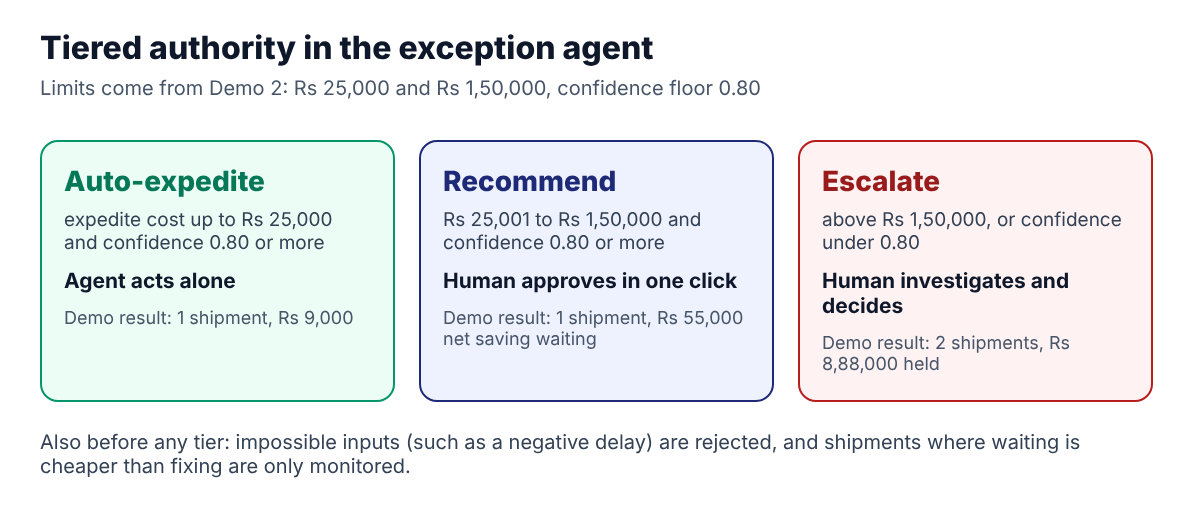
Now the exception use case. Eight late shipments arrive with a delay in hours, an SLA penalty per late hour, the cost to expedite and the model's confidence in its own ETA. The agent first checks the input (a negative delay cannot be true), then compares the cost of waiting with the cost of fixing, then applies tiered authority: act alone below Rs 25,000 with confidence of at least 0.80, ask a human to approve up to Rs 1,50,000, and escalate anything above that or anything the model is unsure about.
import pandas as pd

# Illustrative late-shipment exceptions: delay (hours), SLA penalty per late hour (INR),
# cost to expedite (INR), and the model's confidence in its own ETA prediction.
rows = [
    ("SH-1001", "Bengaluru-Chennai", 6, 4000, 9000, 0.92),
    ("SH-1002", "Mumbai-Delhi", 30, 6500, 140000, 0.88),
    ("SH-1003", "Pune-Hyderabad", 3, 3000, 12000, 0.95),
    ("SH-1004", "Kolkata-Guwahati", 48, 5000, 210000, 0.61),
    ("SH-1005", "Chennai-Kochi", 10, 2500, 30000, 0.90),
    ("SH-1006", "Delhi-Jaipur", -4, 4000, 8000, 0.90),      # bad data: negative delay
    ("SH-1007", "Nhava Sheva-Delhi", 72, 9000, 380000, 0.83),
    ("SH-1008", "Ahmedabad-Indore", 8, 1800, 22000, 0.97),
]
df = pd.DataFrame(rows, columns=["id", "lane", "delay_h", "penalty_per_h", "expedite", "conf"])

AUTO_LIMIT = 25_000       # agent may act alone below this cost
REVIEW_LIMIT = 150_000    # human one-click approval below this; above it, escalate
MIN_CONF = 0.80


def decide(r):
    # 1) Check step: reject inputs that cannot be true
    if r.delay_h < 0:
        return pd.Series(["REJECT (bad data)", 0, 0])
    wait_cost = r.delay_h * r.penalty_per_h
    if wait_cost <= r.expedite:
        return pd.Series(["MONITOR", 0, 0])
    # 2) Tiered authority: read < recommend < execute
    if r.conf < MIN_CONF:
        return pd.Series(["ESCALATE (low confidence)", r.expedite, wait_cost - r.expedite])
    if r.expedite <= AUTO_LIMIT:
        return pd.Series(["AUTO-EXPEDITE", r.expedite, wait_cost - r.expedite])
    if r.expedite <= REVIEW_LIMIT:
        return pd.Series(["RECOMMEND (human approves)", r.expedite, wait_cost - r.expedite])
    return pd.Series(["ESCALATE (above limit)", r.expedite, wait_cost - r.expedite])


df[["action", "spend", "net_saving"]] = df.apply(decide, axis=1)
df["wait_cost"] = (df.delay_h.clip(lower=0) * df.penalty_per_h)
print(df[["id", "lane", "delay_h", "wait_cost", "expedite", "conf", "action"]].to_string(index=False))
print()
counts = df.action.str.split(" ").str[0].value_counts()
print(counts.to_string())
acted = df[df.action.isin(["AUTO-EXPEDITE"])]
print()
print("Spend the agent can commit alone: Rs", int(acted.spend.sum()))
print("Net saving on those auto actions: Rs", int(acted.net_saving.sum()))
rec = df[df.action.str.startswith("RECOMMEND")]
print("Net saving waiting on a human click: Rs", int(rec.net_saving.sum()))
esc = df[df.action.str.startswith("ESCALATE")]
print("Decisions held for people (value at stake, Rs):", int(esc.wait_cost.sum()))
Real output from our run:
     id              lane  delay_h  wait_cost  expedite  conf                     action
SH-1001 Bengaluru-Chennai        6      24000      9000  0.92              AUTO-EXPEDITE
SH-1002      Mumbai-Delhi       30     195000    140000  0.88 RECOMMEND (human approves)
SH-1003    Pune-Hyderabad        3       9000     12000  0.95                    MONITOR
SH-1004  Kolkata-Guwahati       48     240000    210000  0.61  ESCALATE (low confidence)
SH-1005     Chennai-Kochi       10      25000     30000  0.90                    MONITOR
SH-1006      Delhi-Jaipur       -4          0      8000  0.90          REJECT (bad data)
SH-1007 Nhava Sheva-Delhi       72     648000    380000  0.83      ESCALATE (above limit)
SH-1008  Ahmedabad-Indore        8      14400     22000  0.97                    MONITOR

action
MONITOR          3
ESCALATE         2
AUTO-EXPEDITE    1
RECOMMEND        1
REJECT           1

Spend the agent can commit alone: Rs 9000
Net saving on those auto actions: Rs 15000
Net saving waiting on a human click: Rs 55000
Decisions held for people (value at stake, Rs): 888000| Outcome | Shipments | What the agent did |
|---|---|---|
| Monitor | 3 | Waiting costs less than fixing, so nothing is spent |
| Auto-expedite | 1 | Rs 9,000 spent alone, Rs 15,000 net saving |
| Recommend | 1 | Rs 55,000 net saving queued for a one-click human approval |
| Escalate | 2 | Rs 8,88,000 of delay cost held for people (one low confidence, one above the limit) |
| Reject | 1 | Negative delay is impossible, so the record is flagged as bad data |
What this shows. The agent handled the easy cases and committed only Rs 9,000 by itself. The Kolkata-Guwahati shipment would have looked attractive to a naive optimiser (Rs 30,000 apparent net saving), but with a confidence of 0.61 the agent refused to act and sent it to a person. The Delhi-Jaipur record with a negative delay never reached the decision step. Those two behaviours, escalating on low confidence and rejecting impossible inputs, are what separate a safe agent from a fast one. The rule is deterministic Python with no model calls; in production a language model would sit around it to read emails and write messages, while the money decisions stay in code you can test.
How to architect a supply chain agent safely
A reliable design has five parts. None of them is exotic, and all of them are testable.
| Component | What it does | Why it matters |
|---|---|---|
| Data layer | One agreed source for orders, inventory, shipments and rate cards | Agents amplify bad master data; they do not fix it |
| Tools | Narrow functions the agent can call: get shipment, get stock, draft email, book expedite | Fewer tools means fewer ways to go wrong |
| Policy layer | Authority tiers, rupee limits, confidence floors, blocked actions | Keeps the decision rules in code, not in a prompt |
| Check step | Validates inputs and outputs: ranges, row counts, reconciliations | Catches the bad record before it triggers an action |
| Logs and approvals | Every observation, decision and action recorded; humans approve above limits | Lets you audit, learn and roll back |
Two connecting standards are worth knowing. The Model Context Protocol (MCP) gives agents a standard way to call tools and read data from your systems; see What Is MCP?. For larger designs, multi-agent setups split work between specialist agents, such as a demand agent, a transport agent and a supplier agent, coordinated by a supervisor; see AI Agents & Multi-Agent Orchestration and How to Build a Multi-Agent Workflow with LangGraph. Multi-agent designs add coordination risk, so earn them with a working single agent first.
Learn it live: Want to build a supervised multi-agent workflow end to end? Explore Generative AI, or talk to a mentor.
How much time and money can an agent save? A worked example
Here is a transparent way to estimate the benefit, using the same exception queue. The inputs are illustrative: 140 exceptions a day, 12 minutes each when handled manually, and an agent that sorts them into three groups with different human review times.
| Group | Share of exceptions | Human minutes each | What the human does |
|---|---|---|---|
| Auto | 35% | 1 | Glances at the log |
| Recommend | 45% | 4 | Reads the proposal and approves |
| Escalate | 20% | 15 | Investigates and decides |
--- Time-saved model (illustrative inputs) ---
Manual handling: 28.0 h/day
With agent (review time included): 12.0 h/day
Time freed: 16.0 h/day = 57%
Monthly value of time freed: Rs 249,340
Monthly run cost (model + tools, Rs 15/exception): Rs 54,600
Net, before build and maintenance time: Rs 194,740
The calculation uses Rs 600 per planner hour, 26 working days a month and Rs 15 of model and tool cost per exception. All of these are assumptions you should replace with your own. The figure excludes build time, integration work, maintenance and the cost of mistakes, which are real and largest in the first quarter. Note also that escalated cases now take 15 minutes because the hard ones are all that remain; the agent does not make them easier, it makes them rarer on a planner's desk. Treat the result as a way to structure a business case, not as a promise.
Common mistakes when deploying supply chain agents
1. Starting with the glamorous use case. Live re-routing is exciting and risky. Invoice matching and exception triage are dull and safe. Start dull.
2. Handing over authority before fixing data. If lead times in the system are wrong, a perfect agent will optimise against fiction.
3. Putting the limits in the prompt. A rupee limit written in natural language can be argued around. Put it in code.
4. No input checks. The negative-delay record in Demo 2 is mild. In real systems the bad record is a duplicated order or a unit-of-measure mix-up.
5. Ignoring confidence. An agent that always acts is not a good agent. Define the confidence below which it must ask.
6. Optimising one node. Cutting transport cost by expediting less can raise stock-outs downstream. Measure end-to-end service and cost.
7. No rollback path. If an action cannot be undone, it belongs in the human tier.
8. Skipping change management. Gartner explicitly points leaders at the adjacent layers: data management, operations management and workforce readiness. A planner who does not trust the agent will redo its work and erase the gain.
Gartner has also predicted, in a June 2025 press release, that over 40% of agentic AI projects will be cancelled by the end of 2027. Read that as a reason to start small, measure value early and keep risk controls in place, which is what the mistakes above come down to.
The India angle: why this matters for Indian supply chains
Indian logistics is large, diverse and cost-sensitive, which makes exception handling unusually valuable. An NCAER study for the Department for Promotion of Industry and Internal Trade, Assessment of Logistics Cost in India, estimated logistics cost at 7.97% of GDP, well below the 13 to 14% figure often quoted from earlier external studies. The study used a hybrid method combining secondary data with nationwide surveys. The lower number is good news, but it also means the remaining gains are in execution detail: fewer delays, less idle inventory and better use of capacity. That is where agents help.
| Indian context | Why agents help |
|---|---|
| Multi-modal movement (road, rail, port, air) | Exceptions arise at every handover; agents can watch all of them |
| Festive-season demand spikes | Safety stock and reorder points need frequent recomputation |
| Many small suppliers and transporters | Follow-up and document matching consume planner time |
| E-way bill, GST and document checks | Rule-checkable work suits agents with strong validation |
| Global capability centres and large retailers | Analytics teams already own the data layer agents need |
A practical note on language and documents: Indian supply chains deal with invoices, lorry receipts and PODs in varied formats and sometimes several languages. Extraction by AI is useful, but every extracted amount should be reconciled against a second source before it triggers payment. Check any regulatory requirement, such as GST or e-way bill rules, against current official guidance before automating it.
Your 30-60-90 day plan
| Phase | Goal | What to do | Exit check |
|---|---|---|---|
| Days 1 to 30 | Understand and baseline | Pick one exception type. Log 30 days of manual handling time, cost and outcomes. Write the decision rule in plain words. Fix the data fields it needs | A written rule and a baseline you trust |
| Days 31 to 60 | Recommend only | Build the agent at read and recommend level with input checks and logs. Run it beside planners and compare its proposals with their decisions | Agreement rate with planners and zero unsafe proposals |
| Days 61 to 90 | Limited execution | Allow auto-action below a small rupee limit with a confidence floor. Keep an easy kill switch. Review every action weekly | Measured time saved, no unrecoverable errors |
After 90 days, widen one dimension at a time: a larger limit, a second exception type or a second lane. Never widen two at once, because you will not know which change caused a problem.
Skills that make you valuable in agentic supply chains
Whether you are an analyst, a planner or an engineer, the same skills transfer. SQL lets you read and validate the data an agent uses. Python lets you write the policy layer and the checks. Supply chain fundamentals (service level, safety stock, lead time, cost to serve) let you judge whether a rule makes sense. Evaluation and governance let you prove the agent is safe. Communication lets you explain to a head of operations why the agent escalated a decision. The role that grows is the person who can both read the P&L impact and read the agent's log.
Learn it live: Build supply chain and analytics agents with real datasets, review from a mentor and interview preparation included. Explore Data Science with AI or Data Analytics with Agentic AI, or talk to a mentor.
Frequently asked questions
What are AI agents in supply chain and logistics?
They are software systems that monitor supply chain data, decide a next step, use tools such as an ERP, TMS or routing engine to act, check the result and escalate to a human when risk or uncertainty is high. They differ from a forecasting model, which only predicts, and from a rules bot, which cannot adapt when inputs change.
How are AI agents used in logistics today?
The most practical uses are exception management for late or damaged shipments, replenishment support, supplier follow-up, freight invoice matching, warehouse task coordination and route re-planning within limits. Most organisations begin with recommendations and drafts, and allow automatic action only for small, reversible decisions.
What is the difference between AI agents and traditional supply chain automation?
Traditional automation, such as RPA or fixed rules, follows a script and fails when the situation changes. An AI agent can read varied inputs, plan several steps, choose among tools and adapt, while still operating inside limits you define. In practice, the agent often calls a forecast, a solver or a rule check as one of its tools.
Which supply chain tasks should AI agents not do alone?
Large-spend decisions, safety-critical decisions, contract changes, supplier selection and anything irreversible. Also avoid autonomous action where master data is unreliable. Keep these in a human approval tier and let the agent prepare the evidence.
How do I make sure an AI agent does not overspend or make a costly mistake?
Put approval thresholds in code, not in the prompt. Use tiers such as auto-act below a small rupee limit, human approval up to a higher limit, and escalation above it. Add a confidence floor, validate every input, log every action and keep a kill switch. Our demo commits only Rs 9,000 on its own for exactly this reason.
How much can AI agents reduce supply chain costs?
It depends on your baseline, and published figures are mostly vendor claims. In our illustrative model, an exception agent frees about 57% of handling time and nets about Rs 1.9 lakh a month before build and maintenance costs, using assumed inputs. Measure a 30-day manual baseline before you promise any saving.
What data do supply chain agents need?
Reliable orders, inventory, shipment status and ETA, supplier lead times, rate cards and cost-to-serve data, plus clear definitions of service level and exception types. Poor master data is the most common reason pilots fail, so fix it first.
What is a control tower, and how do agents fit in?
A control tower is a unified view of orders, inventory and shipments. Agents make it active: instead of people watching dashboards, agents monitor events, estimate the cost of delay, and propose or take small actions, escalating the rest.
Will AI agents replace supply chain planners?
They replace tasks, not the role. Routine chasing, matching and triage shrink, while policy-setting, exception judgement, supplier relationships and trade-off decisions grow in importance. Planners who can supervise agents and read their logs become more valuable.
How accurate is the Gartner forecast for agentic AI in supply chain software?
It is a forecast, not a measurement. Gartner's April 2026 press release projects spend growing from under $2 billion in 2025 to $53 billion in 2030, and adoption among SCM software users rising from 5% to 60%. Treat it as a direction of travel, and note Gartner also expects real deployment to lag product availability.
What is the best first AI agent project in a supply chain?
One exception type with a clear rule, clean data and small stakes, such as late-shipment triage or invoice matching. Run it at read and recommend level first, compare with planners for a month, then allow limited action.
Is agentic AI relevant for supply chain professionals in India?
Yes. Indian logistics involves many handovers, many small partners and strong seasonal swings, all of which create exceptions. NCAER's estimate of logistics cost at 7.97% of GDP suggests the remaining gains are in execution, which is what agents target. SQL, Python and supply chain fundamentals are the portable skills.
Recommended reading on Skillancy
- The Role of Agentic AI in Automating Everyday Analytics Tasks
- Agentic AI for Analysts: 5 Repetitive Tasks You Can Automate This Month
- AI Agents & Multi-Agent Orchestration: The Complete 2026 Guide
- How to Build a Multi-Agent Workflow in Python with LangGraph
- What Is MCP (Model Context Protocol)? Build Your First MCP Server in Python
- Data Analytics with AI in 2026: How AI Is Changing the Data Analyst Role
- Data Analyst Skills in 2026
- Python for Data Analysis: A Complete Beginner's Roadmap
Sources
- Gartner press release, "Gartner Forecasts Supply Chain Management Software with Agentic AI Will Grow to $53 Billion in Spend by 2030" (7 April 2026): https://www.gartner.com/en/newsroom/press-releases/2026-04-07-gartner-forecasts-supply-chain-management-software-with-agentic-ai-will-grow-to-53-billion-in-spend-by-2030
- Gartner press release, "Gartner Identifies Top Supply Chain Technology Trends for 2026" (30 June 2026): https://www.gartner.com/en/newsroom/press-releases/2026-06-30-gartner-identifies-top-supply-chain-technology-trends-for-2026
- Gartner press release, "Gartner Predicts Over 40% of Agentic AI Projects Will Be Canceled by End of 2027" (25 June 2025): https://www.gartner.com/en/newsroom/press-releases/2025-06-25-gartner-predicts-over-40-percent-of-agentic-ai-projects-will-be-canceled-by-end-of-2027
- Tech Observer, "India publishes first official estimate of logistics costs at 7.97% of GDP", reporting NCAER's Assessment of Logistics Cost in India for DPIIT: https://techobserver.in/news/egov/india-publishes-first-official-estimate-of-logistics-costs-at-7-97-of-gdp-317087/
Gartner figures are taken from the press releases above, not from the underlying research reports; the NCAER figure is as reported by Tech Observer. Vendor descriptions of warehouse and multi-agent capabilities are vendor claims and were not independently verified. All other numbers in this article come from the code shown, run as described below.
Reproducibility note
Both code blocks were run with Python 3, pandas and NumPy on 5 November 2026, and the outputs shown are copied from those runs (Demo 1 uses seed 7 and 200 repetitions per SKU). The time-saved model is the last section of the Demo 2 script. All inputs, including SKU demand, lead times, costs, shipment delays, penalties, confidence values, planner rates and review times, are illustrative and were chosen by the authors; none is real company data or a measured benchmark. The exception agent is rule-based and makes no model calls. The time-saved figure excludes build, integration and maintenance time. Simulated fill rates depend on the assumed demand distribution and ordering rule.
Learn it live: Ready to build supervised AI agents for operations, analytics and supply chain problems with a mentor? Explore Data Analytics with Agentic AI, Generative AI, Data Science with AI, or talk to a mentor. Learn. Build. Get hired.
Get the Skillancy field notes
One email a week: AI and analytics guides, cohort dates and hiring signals. No spam, unsubscribe anytime.