


AI Agents & Multi-Agent Orchestration: The Complete 2026 Guide
From answering questions to running entire pipelines — AI agents are no longer tools, they are teammates. Your complete guide to autonomous AI workflows, LLM orchestration, MCP, RAG, and how to build AI agents in 2026.
- AI agents are LLM-powered systems that plan, use tools, and act autonomously — far beyond a chatbot.
- Multi-agent orchestration delegates sub-tasks to specialised agents in parallel, compressing days of work into minutes.
- MCP (Anthropic) and A2A (Google) are the 2026 open protocols making agents composable across platforms.
- RAG grounds agents in private or real-time data without model retraining.
- Gartner projects 40% of enterprise apps will embed agents by end of 2026, up from under 5% in 2025.
- The 2026 agentic AI skill stack: Python → LLM APIs → LangChain / CrewAI → RAG → multi-agent patterns.
What exactly is an AI agent?
Think of a traditional AI model as a very smart calculator — you give input, it gives output, and waits. An AI agent is fundamentally different. It perceives its environment, sets sub-goals, plans multi-step actions, uses external tools (search, code execution, database queries, APIs), and executes — often without a human prompting each step.
In 2026, agents have moved from chatbot assistants to autonomous workers. A data analytics agent can receive “summarise last quarter’s churn trends,” query the warehouse, run Python analysis, generate a chart, and email a report — entirely without hand-holding. This is exactly the kind of autonomous capability Skillancy’s Data Analytics with Agentic AI course trains learners to build.
An AI agent is an autonomous software system that uses a large language model as its reasoning core to perceive inputs, plan multi-step actions, call external tools, and complete tasks with minimal human intervention — distinguishing it from a passive chatbot that only reacts to single prompts.
At Skillancy, learners in our Data Analytics with Agentic AI programme consistently report the same turning point: the moment their first autonomous data pipeline runs without prompting. One cohort built an agent that queried live sales data, flagged anomalies, and emailed a plain-English summary — in under 2 hours of workshop time. The same pipeline would have taken a junior analyst a full working day to produce manually.
What is multi-agent orchestration?
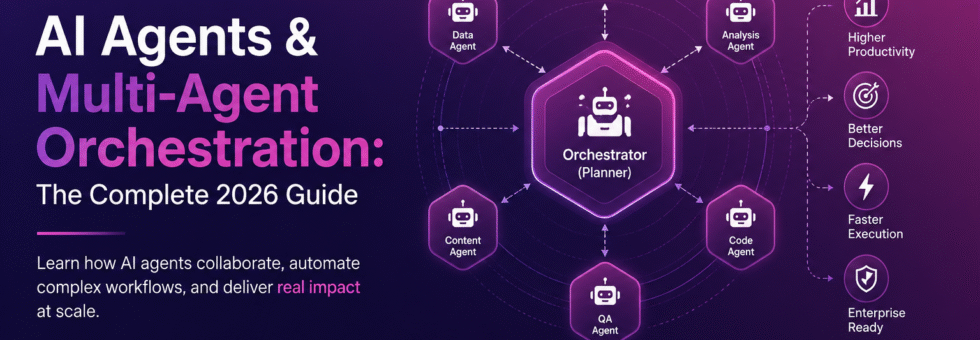
A single agent is powerful. Multiple agents working together is a force multiplier. Multi-agent orchestration is the architecture where a central orchestrator agent coordinates several specialised sub-agents — each an expert in its domain — to complete complex, long-horizon tasks collaboratively and in parallel.
Multi-agent orchestration is an AI architecture where a central orchestrator agent decomposes a goal into sub-tasks and delegates each to a specialised sub-agent — enabling parallel, complex autonomous workflows that exceed what any single AI agent can accomplish independently.
In our Analytics AI Launchpad and Data Analytics with Agentic AI courses at Skillancy, learners build multi-agent pipelines from scratch — and consistently see research-and-synthesis tasks complete 4–7x faster compared to single-agent approaches, with significantly fewer errors because each sub-agent operates in a tighter, more focused context.
Agent types in a multi-agent system
Decomposes goals, delegates to sub-agents, merges outputs.
Searches, retrieves and ranks documents, synthesises knowledge.
Writes, tests, and executes code in sandboxed environments.
Queries databases, runs models, builds data visualisations.
“Perhaps most important, the multi-agent design pattern gives us, as developers, a framework for breaking down complex tasks into subtasks. Even though some LLMs today can accept very long input contexts, their ability to truly understand long, complex inputs is mixed. An agentic workflow in which the LLM is prompted to focus on one thing at a time can give better performance.”
How do agents communicate? MCP and A2A protocols
The biggest agentic AI breakthrough of 2025–2026 is standardised agent protocols. Just as HTTP enabled any browser to talk to any server, two open standards now do the same for AI agents — making them composable, interoperable, and enterprise-ready.
Standardises how AI agents connect to external tools, databases, and APIs — turning bespoke integration code into plug-and-play connectors. De-facto standard since 2025.
Defines how agents from different vendors communicate directly — enabling cross-platform multi-agent collaboration. Complementary to MCP, not competing.
MCP handles agent-to-tool connections; A2A handles agent-to-agent communication. Together they form the plumbing of the agentic web — analogous to HTTP for the internet.
How to build AI agents for data science and analytics
Across Skillancy’s cohorts in Data Science with AI and Data Analytics with Agentic AI, one pattern is consistent: learners who master the full stack — from RAG architecture through multi-agent orchestration — build production-ready agent pipelines in roughly half the time of those who jump straight to frameworks without understanding the fundamentals.
- Autonomous data pipelines: Agents monitor data quality, flag anomalies, trigger ETL jobs, and alert teams — replacing manual monitoring with a continuous autonomous AI workflow.
- AI-powered BI: Business users ask questions in plain English; the agent writes SQL, runs it, and returns a chart with a natural-language explanation.
- RAG-powered enterprise search: Agents pull internal documents at inference time, grounding responses in private or real-time data without model retraining.
- MLOps automation: Agents monitor model drift, trigger retraining, run A/B evaluations, and redeploy — closing the ML lifecycle with minimal human intervention.
- Multi-agent research synthesis: Specialised agents read papers, extract findings, resolve conflicts, and produce structured reviews in minutes instead of weeks.
How to build AI agents — Skillancy’s Agentic AI skill roadmap 2026
Python fundamentals + data literacy
Learn Python (NumPy, Pandas), basic SQL, and APIs. This is the foundation every subsequent step depends on.
~4 weeksPrompt engineering + LLM API usage
Use the Anthropic and OpenAI APIs directly. Master system prompts, few-shot examples, and structured output formats.
~2 weeksTool-calling and agent loops
Build a minimal agent from scratch using ReAct / Plan-and-Execute BEFORE touching frameworks. Skipping this step causes weeks of rework in production.
~3 weeksRAG pipelines + vector databases
Implement Retrieval-Augmented Generation using Pinecone, Weaviate, or pgvector. Build ingestion, chunking, embedding, and retrieval pipelines.
~3 weeksAgent frameworks — LangChain or CrewAI
Apply LangChain agents or CrewAI multi-agent crews to real tasks. Learn memory, callbacks, and tool registries.
~3 weeksMulti-agent orchestration + MCP
Design orchestrator-sub-agent architectures. Integrate MCP for tool connectivity. Add guardrails, audit logging, and human-in-the-loop checkpoints.
~4 weeksAcross our Data Analytics with Agentic AI and Analytics AI Launchpad programmes in 2025, the step most learners initially skipped — and later returned to — was Step 3: building a raw agent loop before picking a framework. Every learner who skipped it hit the same wall: unpredictable agent behaviour they couldn’t debug. The 3 weeks spent on this step consistently saves 4–6 weeks of confusion later.
Frequently asked questions about AI agents
What is an AI agent?
What is multi-agent orchestration?
What is the difference between an AI agent and a chatbot?
What skills do I need to build AI agents?
What is RAG and why does it matter for AI agents?
Is agentic AI safe to deploy in production?
The Bottom Line
The shift from AI-as-a-tool to AI-as-a-colleague is happening now. Organisations and individuals that invest in understanding multi-agent orchestration — not just using it through a GUI — will move decisively faster than those who treat it as a black box.
Skillancy’s Data Analytics with Agentic AI programme follows this exact six-step roadmap with hands-on projects, live mentorship, and a job-ready portfolio. Do not skip step 3.
Explore the Course at Skillancy