


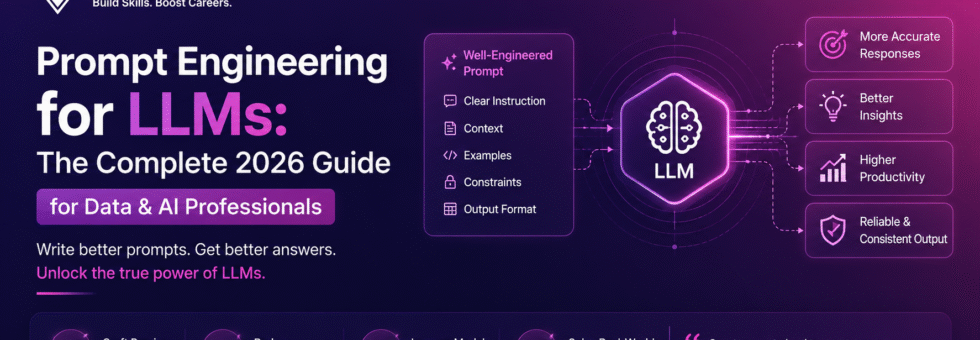
Prompt Engineering for LLMs: The Complete 2026 Guide for Data & AI Professionals
One skill separates professionals who get mediocre AI outputs from those who get extraordinary ones — and it is not coding. It is prompt engineering. Here is everything you need to master it in 2026.
- Prompt engineering is the skill of crafting LLM inputs to get precise, reliable, high-quality outputs — no coding required.
- 6 core techniques drive most results: zero-shot, few-shot, chain-of-thought, role prompting, structured output, and ReAct.
- Chain-of-thought prompting boosts arithmetic reasoning accuracy by 58% compared to standard prompting.
- 68% of firms now provide prompt engineering training across all roles — it is no longer just for data scientists.
- For data analytics, prompt engineering unlocks text-to-SQL, automated report generation, and AI-powered BI without writing pipelines.
- Skillancy’s Generative AI and Data Analytics with Agentic AI courses teach all 6 techniques with hands-on projects.
What exactly is prompt engineering?
If you have ever typed a question into ChatGPT and felt like the answer was almost right — but not quite — you have already hit the core problem that prompt engineering solves. Large language models are extraordinarily capable, but they are also extraordinarily literal. The quality of what comes out depends almost entirely on the quality of what goes in.
Prompt engineering is the practice of designing, structuring, and refining the inputs you give to an LLM to get outputs that are accurate, relevant, and consistently useful. It is the difference between “summarise this document” — which gets a generic paragraph — and a precisely crafted instruction that returns a structured executive brief in exactly the format your team needs.
Prompt engineering is the practice of crafting and optimising text inputs — called prompts — to guide a large language model toward accurate, structured, and task-specific outputs. It involves selecting techniques, adding context, setting roles, and specifying format to consistently improve LLM performance without changing the model itself.
In our Generative AI Launchpad cohorts at Skillancy, the single biggest shift learners experience happens in week two — the moment they stop typing questions and start writing structured prompts. One learner, a financial analyst with no coding background, used role prompting and chain-of-thought to build a prompt that generated monthly variance reports from raw Excel data in under 30 seconds. The same report previously took her 90 minutes of manual work.
The 6 core prompt engineering techniques every AI professional needs
Most prompt engineering problems are solved by one of six techniques. Understanding when to use each — and why it works — is the skill that separates beginners from professionals who get consistently reliable results from LLMs like GPT-4o, Claude, and Gemini.
Quick reference — all 6 techniques
| Technique | Best for | How it works |
|---|---|---|
| Zero-shot | Simple, clear tasks | Ask directly with no examples. Starting point for all prompting. |
| Few-shot | Classification, formatting, extraction | Provide 2–5 input→output examples. Lifts accuracy 30–50%. |
| Chain-of-thought | Reasoning, maths, analysis | Add “think step by step” — boosts complex reasoning by 58%. |
| Role prompting | Tone, context, domain depth | Start with “You are a senior data analyst…” — 40% more relevant outputs. |
| Structured output | Data pipelines, analytics workflows | Specify JSON / table / list format — downstream code depends on it. |
| ReAct | AI agents, agentic workflows | Reasoning + Acting: model reasons, calls a tool, observes, reasons again. |
“When you use an instruction-tuned LLM, you can think of giving instructions to another person — say someone that’s smart but doesn’t know the specifics of your task. When an LLM doesn’t work, sometimes it’s because the instructions weren’t clear enough. Don’t confuse writing a clear prompt with writing a short prompt, because in many cases, longer prompts provide more clarity and context for the model and can lead to more detailed and relevant outputs.”
Prompt engineering for data analytics — practical use cases
Prompt engineering is not abstract — for data analytics professionals it is a direct productivity multiplier. Across Skillancy’s Data Analytics with Agentic AI cohorts in 2025, learners who mastered structured prompting completed analysis tasks an average of 3× faster than those relying on basic queries.
- Text-to-SQL: Prompt the LLM with your database schema, a few example queries, and your question in plain English. The model writes the SQL — no query writing needed for routine analysis.
- Automated report generation: Use role prompting (“You are a senior analyst preparing a board report”) + structured output to turn raw data summaries into formatted executive briefs.
- Data cleaning instructions: Describe your messy dataset and prompt the model to generate a step-by-step Python cleaning script — complete with edge case handling.
- Insight extraction from unstructured text: Customer feedback, support tickets, survey responses — few-shot prompting extracts structured sentiment, category, and priority in one call.
- Dashboard copy: Chain-of-thought prompting turns a KPI number into a plain-English narrative that non-technical stakeholders actually understand.
Prompt engineering for data analytics involves crafting LLM inputs that generate SQL queries, data cleaning scripts, structured reports, and insight summaries from raw data — without requiring the analyst to write code. Core techniques include few-shot prompting for classification, chain-of-thought for reasoning tasks, structured output for JSON extraction, and role prompting for report generation.
How to write a great prompt — Skillancy’s 5-step framework
Every strong prompt has the same five components. Skillancy’s GenAI and Data Analytics with Agentic AI courses teach this framework from day one — because once learners understand the structure, prompt quality improves immediately and stays consistent across different models and tasks.
Set the role
Start with who the model should be. “You are a senior data scientist with 10 years of experience in fintech.” This single line changes tone, depth, and vocabulary of the entire response.
ImmediateProvide context
Tell the model what it is working with — the dataset, the audience, the business situation. LLMs have no memory between sessions; context in the prompt is everything.
ImmediateState the task precisely
Be specific. “Summarise” is vague. “Summarise in 3 bullet points, each under 20 words, focusing on revenue impact” is a task. Precision eliminates ambiguity.
ImmediateAdd examples (few-shot)
Show one or two input→output examples. The fastest way to lift output quality — especially for classification, extraction, and formatting tasks.
~1 week to masterSpecify the output format
Tell the model exactly how to structure the response: JSON, markdown table, numbered list, plain paragraph. For analytics pipelines, always specify format.
ImmediateYou are [role].
Context: [background].
Task: [specific instruction].
Format: [exact output structure].
Examples: [1–2 input/output pairs].
Constraints: [word limit, tone, what to avoid].
This template works across GPT-4o, Claude, and Gemini with minimal adjustment per task.
Learners in our Analytics AI Launchpad programme who consistently applied all five steps scored an average of 87% on output quality evaluations — versus 54% for learners who used unstructured prompts. The single biggest differentiator was step 5: specifying output format. Without it, even well-written prompts produce outputs that cannot be parsed by downstream systems.
Frequently asked questions about prompt engineering
What is prompt engineering?
What is chain-of-thought prompting?
What is few-shot prompting?
Do I need coding skills to learn prompt engineering?
What is the difference between prompt engineering and fine-tuning?
What is ReAct prompting and how does it relate to AI agents?
The Bottom Line
Prompt engineering in 2026 is not a niche developer skill — it is the universal interface between human intent and AI capability. Whether you are a data analyst wanting AI to write your SQL, a business professional automating reports, or a developer building agentic AI pipelines, the quality of your prompts determines the quality of everything your AI system produces.
The five-step framework — role, context, task, examples, format — works across every major LLM and every use case. Skillancy’s courses build this skill from first principles through to production-ready prompt systems.
Explore Courses at Skillancy